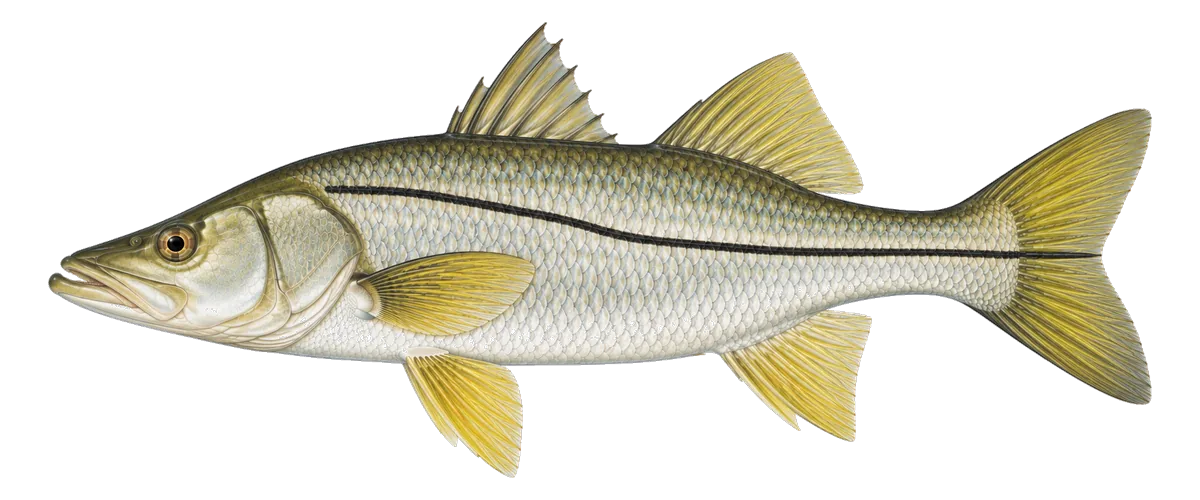
The best bait for snook is a live one that matches what they're eating: scaled sardines (pilchards, or "whitebait") from spring through fall, pinfish and finger mullet as the water cools, and live shrimp in winter. If you'd rather throw lures, a soft plastic shrimp, a white paddletail on a jighead and a suspending twitchbait catch snook in most places, most of the year.
Below: each bait and how to rig it, the lures and how to work them, what changes season by season, and where to fish for snook at night, in canals and off the beach.
The best live bait for snook
Snook are ambush feeders. They sit beside structure in moving water and eat the small fish, shrimp and crabs the tide carries past, and they shift their diet to whatever is plentiful. Match your bait to what's in the water that month and you're most of the way there.
FWC's snook researchers find live bait does its best work in spring and summer, and lures come into their own in winter. Plenty of winter snook still fall to a live shrimp, though.
Pilchards (whitebait)
Scaled sardines are Florida's classic warm-water snook bait. Free-line one on a light circle hook into moving water beside a dock, a mangrove point or a bridge piling, and let the current swim it to the fish.
Most anglers catch their own with a cast net over shallow grass, then hold them in a well-aerated livewell with clean water. Pilchards die fast in warm, stale water. Tossing a handful of live ones near a snook spot ("live chumming") often gets fish feeding before the first hooked bait goes out.
Pinfish
Pinfish are tough, easy to find all year, and a mouthful for a bigger snook. Hook one through the nose and free-line it, or fish it under a float along a mangrove shoreline. In winter, Florida Sportsman's west coast guide suggests a live pinfish of about four inches fished on the bottom in deep holes, where the big fish sit out cold snaps.
Finger mullet
When the fall mullet run pushes down the Atlantic beaches and into the inlets, snook follow it, and a finger mullet is the bait to have. Hook it through the lips to swim it up-current, or through the tail so it swims away from you, back under a dock or into the mangroves.
Live shrimp
Taklbox's snook profile calls live shrimp the most dependable bait in cooler water, and it's the easiest to buy at any bait shop. Drift one under a dock light on a small, strong hook, or hook it through the head on a jighead and work it slowly along the bottom of a deep hole.
Other baits that catch snook
FWC's snook researchers also list live ladyfish, grunts, threadfin herring, tilapia, mojarras, killifish and small blue crabs. In fall and winter, chunks of cut mullet, ladyfish or pinfish left on the bottom draw bites from fish too sluggish to chase. In spring-fed rivers, where some snook spend the winter in fresh water, Florida Sportsman recommends a live freshwater shiner.
How to rig live bait for snook
Snook bait rigs are simple: a circle hook, a fluorocarbon leader and as little weight as the current allows.
- Hook: use a circle hook. FWC's fish-handling guide says circle hooks are 90% more likely to hook a fish in the mouth than in the throat or gut, and most snook go back in the water. Size it to the bait: smaller for shrimp and pilchards, bigger for pinfish and mullet. Florida Sportsman recommends 5/0 to 7/0 circles for big winter baits.
- Setting the hook: don't. When the line comes tight, reel and lift, and the circle hook sets itself in the corner of the mouth.
- Leader: a snook's gill plate is sharp enough to cut line, so tie on a few feet of fluorocarbon. Go heavier around bridges and docks, where a fish will run you into the pilings, and lighter in clear water, where snook get shy. Florida Sportsman suggests 20- to 30-pound for live shrimp under dock lights.
- Weight: free-line whenever you can. Add a split shot only to get a bait down in fast water, and use a sliding sinker for pinfish in deep winter holes.
- Placement: snook won't chase a bait far. FWC's researchers advise casting so the current carries the bait close to the fish without landing on top of it.
The best lures for snook
Lures let you cover water to find the fish, and in winter they often outfish bait. A handful of styles catch snook almost everywhere they live.
Soft plastic shrimp. Skip it under docks and mangrove overhangs, let it sink, give it a twitch and let it fall again. Most bites come on the fall. Florida Sportsman and Salt Water Sportsman both say the common mistake is working it too fast. In winter, a 4-inch shrimp crawled along the bottom is a cold-water standby.
Paddletail on a jighead. A white soft plastic on a jighead, worked through the shadow lines of bridges and lighted docks, is one of the top snook baits in Taklbox's own profile. Florida Sportsman likes a 3-inch paddletail on a quarter-ounce head: skip it under docks, swim it steadily so the tail thumps, and slow down and hop it off the bottom when the fish are lazy. For bridges, spillways and inlets, step up to a heavier swimbait, cast it up-current, let it sink and slow-roll it back.
Suspending twitchbait. These imitate pilchards and finger mullet. Work one along the edges of bait schools on flats and shorelines, or past docks and pilings in current, with a twitch and a long pause. The flash on the twitch draws the fish and the pause gets the bite.
Bucktail and flair hawk jigs. These are the bridge and inlet baits, especially at night. Pick a weight that reaches the bottom in the current, cast up-current, and bring it back slowly and steadily close to the bottom. For color, Florida Sportsman's rule is darker in dark water, lighter in clear water, and white when in doubt.
Topwater plugs. A walk-the-dog plug along seawalls, docks and mangrove points at first light and dusk draws explosive strikes. Salt Water Sportsman notes that some anglers use a monofilament leader with topwaters, since fluorocarbon sinks.
Weedless soft jerkbaits. Rigged on a weedless hook, a soft jerkbait skips deep under mangrove overhangs where other lures hang up. Twitch it erratically, like a dying baitfish.
Flies. Snook take flies well, especially small white baitfish patterns cast to the edge of dock lights at night and to fish cruising the beach in summer.
When snook bite: tide, current and time of day
Moving water matters more than anything else. FWC's snook researchers say to fish the current, preferably the outgoing tide, and that days with four tides fish better than days with two, when the current runs weak. For big snook on bridges, they point to the first two or three hours of the outgoing.
In summer, the bite is mostly at night and early in the morning. In fall, once the water drops into the right range, snook will feed all day, according to Sport Fishing's fall transition guide.
Every spot has its own best tide, and you learn it by keeping track. Taklbox saves each catch with the bait, tide, moon and barometer reading, so after a season you can see what your spots have in common.
Best bait for snook by season
Snook live in Florida and the Caribbean, with a smaller fishery in deep South Texas, and they move with water temperature. On Florida's Atlantic coast they travel between estuaries, while Gulf coast snook tend to stay in one estuary their whole lives, UF/IFAS Extension notes. The seasons below are for Florida; your area can run a few weeks early or late.
Spring. As the water warms, snook leave the rivers and creeks where they wintered and spread back onto the flats and toward the passes, and live bait starts to outfish lures. Florida Sportsman likes a small lipless crankbait in spring and early summer, when the baitfish are small.
Summer. Snook spawn at passes, inlets, river mouths and along the beaches from about April or May through September or October. FWC names Jupiter and Lake Worth inlets on the Atlantic and John's Pass and Clearwater Pass on the Gulf among the known sites. Live pilchards are hard to beat by day, and the dock-light bite turns on at night. Much of the summer is closed to harvest; the rules are further down.
Fall. Once the water drops below about 80°F, snook sense the change and start to move. They feed hard and work shallow first, over flats, mangrove shorelines and oyster bars, then slide toward the rivers, canals and marinas where they'll winter, settling in around November and December. Pilchards, threadfin herring, finger mullet and topwater plugs all shine.
Winter. FWC says snook turn lethargic in water below about 65°F, and Florida Sportsman's winter guide finds they eat little below 70°F. A hard freeze can kill them. They crowd into rivers, spring runs, residential canals, marina basins, dredged holes and power plant outflows. Fish live shrimp or pinfish on the bottom, or lures crawled slowly near it, and downsize: a small bait moving steadily gets bit when a big one doesn't. On sunny afternoons during a warm spell, check the shallow flats near creek mouths, where snook slide out of their refuges to warm up and feed.
The deep holes and dredged basins winter snook stack into show up on a depth chart before you ever see them. Taklbox Pro shades charted depth right on the map.
Best bait for snook at night
Dock and bridge lights draw shrimp and baitfish, and snook come to feed on them, almost regardless of temperature and tide, according to Florida Sportsman. The snook at dock lights are usually smaller; the bigger fish sit on the bridges.
- Where to cast: snook hold in the dark just outside the light, facing into the current. Work the edge of the light and the shadow line, not the bright middle.
- How to present: cast up-current and let the bait or lure swing down along the shadow line, the way food washes past naturally.
- Live bait: a live shrimp drifted into the light with the current, on a small, strong hook and no weight.
- Lures: small white minnow plugs, a white paddletail on a light jighead, or a small white fly at docks. On bridges, a heavier flair hawk or bucktail bounced near the bottom.
Snook under a light see you before you see them. Stay out of the light yourself, keep noise down, and don't shine a flashlight on the water you're about to fish.
Best bait for snook in canals
From late fall through winter, Florida's residential canals and marina basins fill with snook escaping cold, shallow bays. Depth is the draw. Florida Sportsman's west coast guide says water deeper than 6 feet may hold them, and deeper than 10 is almost a sure thing.
Canal snook in winter are slow. A live shrimp on a light jighead, worked along the bottom near docks and seawalls, is the go-to, with a soft plastic shrimp crawled the same way as the lure version. For bigger fish, put a live pinfish or a chunk of cut bait on the bottom in the deepest water you can find, and fish the warmest afternoons.
In the warm months, canal snook feed around lighted docks at night, so the dock-light approach above works there too.
If you're fishing the canals from a small boat or kayak, Taklbox Pro maps the boat ramps and fishing piers nearby.
Best lures for snook off the beach
From about April through late October, snook move from the backcountry onto the beaches to spawn. They cruise the trough just off the sand, and in bright sun they can sit inches from dry beach.
- Stay out of the water. Walk the waterline. Salt Water Sportsman's beach guide puts it plainly: if you're wet above the ankles, you're wading too deep.
- Cast ahead of the fish. Watch which way a snook is moving and land the lure well in front of it, so it swims away from the fish when you retrieve it.
- Fish the middle of the tide. Mid-tide moves the most water and bait. An incoming tide is better, and slack water rarely produces.
- Match the bait. Beach snook mostly feed on small baitfish. Small white or silver lures do the job: a white bucktail or paddletail on a light jighead, a small suspending twitchbait, or a white baitfish fly.
Live pilchards free-lined into the trough work too, if you can keep them alive on the walk.
Much of Florida's beach snook fishing happens on foot from public beaches and parks. Taklbox Pro shades public land on the map, a starting point for finding shoreline to fish.
Snook rules in Florida and Texas
Most snook anglers release most of their fish, but if you plan to keep one, the rules are strict. Florida manages snook with a narrow slot, a snook permit in addition to a saltwater fishing license, closed seasons that differ by coast and region, and hook and line as the only legal gear. The card below has every region, straight from the data Taklbox checks your catch against.
Texas has a small snook fishery in the lower Laguna Madre, mostly around the South Padre Island jetties, South Bay and the Brownsville Ship Channel, and it gets rare north of Port Mansfield. Texas Parks and Wildlife Magazine has called early fall the best time at the South Padre jetty, with live mullet or shrimp fished at night. Texas sets its own slot.
To release a snook well, follow FWC's handling advice:
- Handle it as little as possible, with wet hands, and keep it out of the water only briefly, even for a photo.
- Hold it by the lower jaw, never the gills. A snook's gill plate is razor-sharp.
- For a big fish, put your other hand under the belly to carry its weight, rather than hanging it by the jaw.
- To revive a tired fish, hold it in the water with one hand under the belly and the other on the lower jaw or tail. Don't pump it back and forth; that keeps water from flowing over the gills properly.
- Let it swim off head-first.
Not sure whether the fish in your hands is legal where you caught it? Snap it: Taklbox names it, measures it on iPhone Pro models, and checks the slot, bag and season where you caught it.
Frequently asked questions
What is the best bait for snook in Florida?
Live pilchards in the warm months, live pinfish and finger mullet in fall, and live shrimp in winter. For lures, a soft plastic shrimp, a white paddletail on a jighead and a suspending twitchbait cover most situations.
What's the best bait for snook and redfish?
Live shrimp and live pinfish catch both, and so do a paddletail on a jighead and a soft plastic shrimp. Both fish feed along mangrove shorelines, docks and oyster bars on moving water. Redfish root on the bottom more and love crab, while snook look up for baitfish.
What's the best bait for snook and tarpon?
Live mullet and threadfin herring drifted along bridge shadow lines will draw both. Tarpon run much bigger, though, so fish tarpon tackle if they're around. A live crab drifted through a pass is the classic tarpon bait.
What color lure is best for snook?
White, when in doubt. Florida Sportsman's rule of thumb is darker colors in dark water and lighter ones as the water clears, and white or silver baitfish imitations work on the beaches and under dock lights.
Do snook eat cut bait?
Yes, especially in fall and winter, when sluggish fish won't chase. A chunk of cut mullet, ladyfish or pinfish left on the bottom of a deep hole or canal is an easy meal. For more on what to tie on for other inshore fish, see the Taklbox bait and lure guides and the rest of the Taklbox blog.