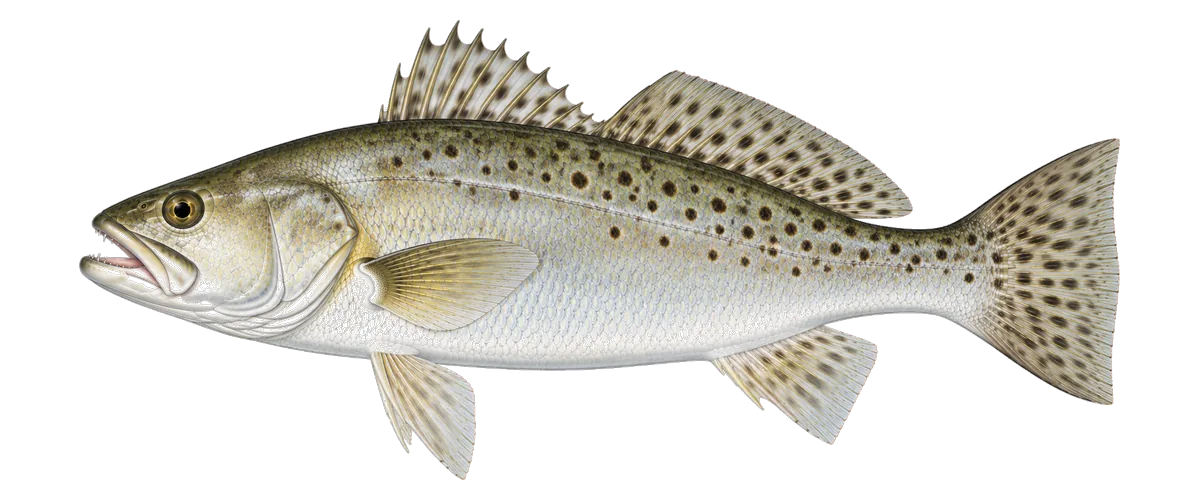
In the fall, speckled trout follow the cooling water off the open grass flats and into the creeks, bayous and rivers, gathering first at creek and river mouths and drains, then moving into deep holes upstream as winter sets in. Along the way they feed hard on the shrimp and baitfish leaving the marsh, which makes October and November some of the best trout fishing of the year.
Below: what moves trout in the fall, when the bite starts, how to find them at the mouths, drains and holes, and how the pattern plays out in Florida, Texas, Louisiana and the Carolinas, with each state's rules.
Where speckled trout go in the fall
Water temperature runs the speckled trout's year. The Atlantic States Marine Fisheries Commission describes trout as sensitive to cold, moving into deeper channels and holes, and sometimes out along the beaches, to get away from it. A Georgia study found the same thing: trout left the shallow edges of the estuaries for deeper creeks and rivers whenever the water got too hot or too cold.
Texas Parks and Wildlife describes the fall version of that move. As the water cools, trout shift from the shallow bays into deeper bay water and the Gulf. In a dry fall, with little rain and runoff, many move into deeper rivers and bayous with the first cool weather.
Most trout don't go far. Tagging and genetic studies in Georgia and Florida show trout keep a small home range and rarely leave the estuary where they were spawned. North of the Carolinas it's different: Chesapeake Bay trout head offshore and south in the fall and come back in spring.
In practice, that makes the fall pattern a two-step move. Salt Water Sportsman's Sid Dobrin describes it on Florida's Gulf coast:
- The mouths. As the flats cool, trout stack up at creek and river mouths, usually by late November there.
- Upstream. As the water keeps cooling into December and January, they move farther up the creeks and rivers into the deep holes.
On the way, the fish feed. Shrimp and small fish pour out of the marsh on falling tides in the fall, and trout set up wherever that food funnels past them.
When the fall speckled trout bite starts
It starts with the water, not the calendar, so it comes earlier the farther north you fish.
- The Carolinas: Little River guide Kyle Hughes finds the trout bite takes off in October, once the creek water drops into the mid-60s and trout start bunching up. Creeks cool faster than the ocean, so they turn on first.
- Florida's Gulf coast: Dobrin starts looking at creek and river mouths once the flats drop below about 65 degrees. Near 55 degrees, he finds the fish move farther upstream.
- Louisiana: Capt. Mike Gallo of Slidell expects trout to push into the Biloxi Marsh around mid-October, and the bite to turn on by about the third cool front.
- Texas: Rockport guide Blake Muirhead finds that once the water stays in the 50s, trout favor mud and shell bottoms over sand and grass.
Each cold front pushes the fish a step deeper, and a warm spell can pull them back out onto the flats. In very cold weather, Texas Parks and Wildlife's advice is to fish deep rivers, harbors and channels just after a norther dies down.
How to find speckled trout in the fall
Creek mouths, drains and points
Hughes looks for trout at the points, the creek mouths and the eddies on the inside of creek bends, wherever bait collects along a channel. Galveston Bay guide James Plaag fishes the drains along the main bay shorelines on a falling tide, along with coves and flats near deep water.
The falling tide is the key. It pulls shrimp and small fish out of the marsh and through the drains, and trout wait at the outflow. Fish the points and the edges where the outgoing water meets the deeper channel.
Deep holes in creeks and rivers
Once the fish move upstream, Dobrin uses a depth finder to look for holes at least 7 to 10 feet deep, especially where creeks join and the current moves. Trout want cover in or beside the hole: mangroves, pilings, oysters, rocks.
His timing: start about 30 minutes after the tide turns to outgoing, once the water starts to flow. The outgoing tide flushes warm water and bait out of the creeks and sets up ambush points at rocky points, cuts and pilings. Anchor beside a hole rather than running over it.
Reading the bottom before you go saves a lot of running around. Taklbox Pro shades charted depth on the map, so the deep bends and holes near your launch show up at a glance.
Under the birds
On the Texas coast, fall means birds. When the shrimp leave the marshes, gulls dive on them over open bay water, and trout feed underneath. West Galveston Bay guide Randall Groves points to the November shrimp run near San Luis Pass, and Matagorda guide Capt. Glenn Ging works birds over shell reefs and bay shorelines.
Groves finds that a topwater plug thrown to the school helps pick the bigger trout out of it.
Fall speckled trout in Florida
The Gulf coast. Here the two-step move is textbook. Dobrin points out that spring-fed creeks and rivers there often run about 72 degrees, much warmer than the Gulf in winter, and trout crowd into them. Look for deep holes where the spring water meets the tide, and fish the outgoing.
Bait for fall in Florida. Dobrin's first choice is a live shrimp, free-lined across the hole on a 2/0 or 3/0 circle hook and 20-pound fluorocarbon leader, with a split shot only if the current needs it. He also uses greenbacks and whitebait. For lures, he lets 3-inch soft plastics sink deep and retrieves them slowly, and slow-trolls a suspending twitchbait to find the schools.
Check your region before you keep one. Florida draws its trout rules by region, and some regions close harvest for part of the year, including in late fall. The card below shows each region.
Texas bays in the fall
Texas trout follow the same pattern across a long coast, as the November reports from Texas Saltwater Fishing Magazine's guides show:
- Galveston Bay: drains on main bay shorelines on falling tides, working birds, and coves and flats near deep water. Plaag finds that cooler water favors slower, thumping topwaters.
- Port O'Connor: Lynn Smith fishes shallow flats that warm in the afternoon sun and sit next to the deep water trout drop into when it turns cold. He starts late in the morning and fishes into the afternoon.
- Corpus Christi: when cold weather pushes trout deep, Joe Mendez finds them in the Intracoastal Waterway and the smaller channels off it, casting from the ditch toward the sandbars on its edges.
- Upper Laguna Madre and Baffin Bay: Robert Zapata finds the cooler water keeps trout in the shallows longer in the morning, on grassy edges and potholes in two to three feet of water.
In a dry fall, Texas Parks and Wildlife adds the rivers and bayous to the list. In very cold weather, after a norther blows through, it points to deep rivers, harbors and channels.
The Louisiana marsh in the fall
Louisiana's trout spend much of the summer in the outside waters around the islands and passes, then move inside the marsh to feed in the fall. Gallo expects them in the Biloxi Marsh from the Chandeleur Islands, Mississippi Sound and Breton Sound around mid-October.
By November, Grand Isle angler Tommy Vidrine finds them spread out: some still in the passes and on the rocks out front, many already inside the marsh behind the island. When a strong cold front hits, the action moves to the bridges along Highway 1 and the first ditches near Grand Isle, usually closer to Thanksgiving. He puts the live bait away in November and throws a 3-inch swimbait, dropping to a 2-inch one when cold trout get finicky.
The Carolinas in the fall
In the Carolinas, the creeks behind the inlets carry the fall bite. Hughes fishes the major creeks and rivers off the Intracoastal Waterway between Little River, South Carolina, and the Lockwood Folly River in North Carolina, and finds the bite holding up toward Christmas. His main rig is a live shrimp under a slip bobber, drifting in the lower third of the water. He keeps a topwater plug rigged for cloudy, overcast days, when October trout turn aggressive.
North Carolina can close trout harvest after a winter cold stun kills fish. The state's marine fisheries division closed the season in early 2025 and again in February 2026, after confirming cold stuns in 10 waterbodies, so check the state's proclamations after a hard freeze.
The best bait for fall speckled trout
Fall trout are feeding up for winter, so they're less picky than at any other time of year. The short list:
- Live shrimp, under a popping cork on the flats and drains or free-lined across a deep hole.
- A soft plastic paddletail or shrimp on a light jighead, worked slower as the water cools.
- A suspending twitchbait for holes and for fish slowed by cold water.
- A topwater plug at dawn and on overcast days, while the water is still warm enough.
For rigging each, and the baits for the biggest trout, see the best bait for speckled trout. Reds are in the same creeks and on the same drains, so where redfish go in the fall is worth a read too.
Every trout you catch is a clue to the next. Taklbox saves each catch with its place, bait, tide, moon and barometer reading, so you can line up this fall's best days with last fall's.
Where speckled trout go in the winter
The fall move ends in the deepest, warmest water around: holes in creeks and rivers, deep channels, harbors and, on Florida's Gulf coast, the spring-fed rivers. On the Atlantic side, some trout move out of the estuaries and along the beaches. Chesapeake Bay trout leave for the ocean.
In winter, fish slowly and fish the warmest part of the day. A cold, slow trout wants a bait it doesn't have to chase.
A hard freeze can stun and kill trout. North Carolina's marine fisheries division describes a cold stun as a sudden drop in water temperature, or a long cold spell, that leaves the fish sluggish: some die outright, and the rest are easy prey for birds. In some states, North Carolina among them, a big enough stun closes the season. Handle any trout you release gently and get it back in the water fast; cold fish are slow to recover.
Before you keep one in the cold months, snap it: Taklbox names it, measures it on iPhone Pro models, and checks the size, bag and season where you caught it.
Frequently asked questions
Where do speckled trout go in the winter?
Into the deepest, warmest water nearby: holes in creeks and rivers, deep channels and harbors, and spring-fed rivers on Florida's Gulf coast. Some Atlantic coast trout move out along the beaches, and Chesapeake Bay trout head south and offshore.
Are speckled trout in season right now?
In most states, yes: speckled trout are open year-round, with a size limit. Some states and regions close for part of the year, and North Carolina can close after a cold stun, so check the card for your state above.
What water temperature do speckled trout like?
In the Chesapeake, the ASMFC describes adults favoring shallow, grassy, brackish water between about 59 and 81 degrees. In fall, guides find the bite turns on as the water drops into the mid-60s.
When is the best time to catch speckled trout in the fall?
On a falling tide, at drains and creek mouths. As fronts get colder, fish the deep water just after a front passes. In late fall, the afternoon is often better than the morning, once the sun has warmed the shallows.
Do speckled trout move with the tide?
Yes. On a falling tide they set up at drains, creek mouths and points to feed on bait washing out of the marsh. On a rising tide they spread back out over the flats and into the grass.