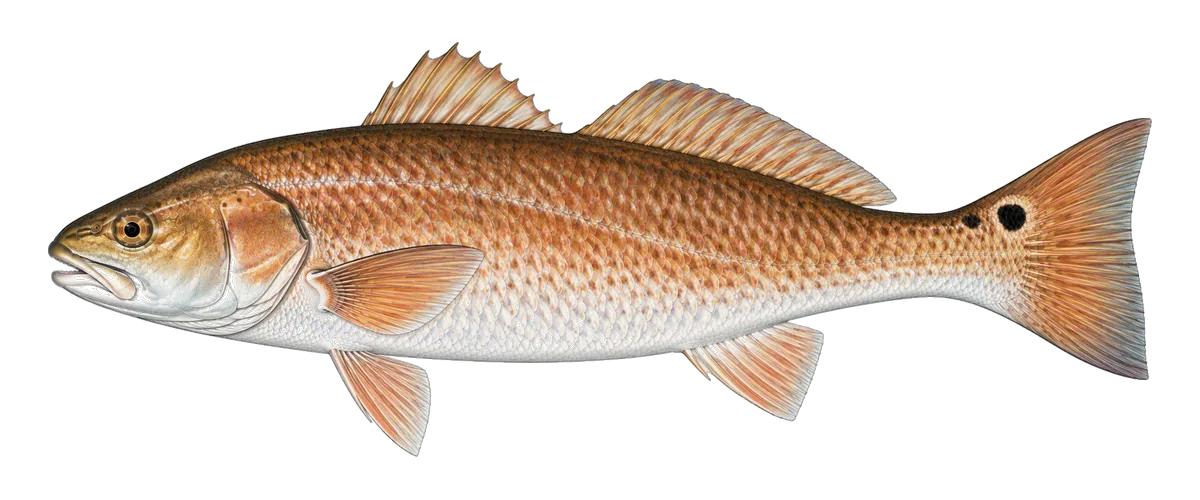
In the fall, redfish go two ways. The big adults, the bull reds, come in from open water to the passes, inlets, jetties and beaches to spawn, from about August into November depending on the coast. The younger fish stay inside the bays, school up as the water cools, and feed hard on flats, oyster bars and marsh drains until winter cold pushes them into deeper creeks, rivers and holes.
Below: when the run happens and the water temperatures behind it, where the bulls stack up, what fall looks like on Florida's Gulf and Atlantic coasts, in the Texas bays and in the Louisiana marsh, and how tides and fronts move the fish in October.
Where redfish go in the fall
A redfish's fall depends on its age. FWC says redfish are an inshore fish until they are about four years old and roughly 30 inches long, and LSU's Sea Grant fisheries fact sheet says that by age four or five almost all of them have left the estuaries to join the offshore schools of adults. Those adults come back toward the coast every late summer and fall to spawn.
The bulls gather at the doors between the bays and the open water: passes, inlets, jetties and the beaches beside them. FWC puts Florida's spawning season at about August through December, "in passes, inlets and lagoon estuaries around the state." Once it's over, most of them head back out. In Georgia, adult reds tagged on shoals and beaches in the fall turned up about 6 to 14 miles offshore that winter, and back at the same spot the next spring, according to the Atlantic States Marine Fisheries Commission's habitat review.
The younger reds stay inside but shift around. The same review describes young reds moving out of the rivers in fall to saltier water: the grass flats and shoals along the barrier islands, and the front beaches. Fish that spent the summer near inlets are the likeliest to slide into the surf. When winter sets in, they leave the shallow creeks for deeper channels.
Texas Parks and Wildlife sees little true migration in its bay reds. They move daily between the shallows and deeper water with the tide and the temperature, and a cold spell crowds large numbers of them into tidal creeks and rivers.
When do redfish run?
"The redfish run" usually means the bulls' spawning run. It starts in late summer everywhere and lasts longest on Florida's coasts:
- Texas: mid-August through mid-October, in Gulf waters near the mouths of passes and along the beaches, according to Texas Parks and Wildlife.
- Louisiana: late summer and early fall. Louisiana Sportsman reports bulls filling Caminada Pass at Grand Isle from August to mid-October, and moving through Lake Borgne and the Rigolets from late August to about mid-November.
- Florida: about August through December, according to FWC.
Water temperature drives it. In lab studies cited in the ASMFC review, red drum spawned in water from about 72 to 86°F, best from about 72 to 77°F. In a South Carolina study that copied Charleston Harbor's natural conditions in tanks, reds released eggs as the water cooled from its August peak of about 86°F, and stopped at about 77°F. In Mosquito Lagoon, researchers found viable redfish eggs at daily average water temperatures of about 68 to 77°F.
Put simply, the run builds as hot summer water starts to cool and fades as the fronts chill it. Around Barataria Pass, Louisiana Sportsman notes, bulls stay in good numbers "until regular fall cold fronts push through."
The run comes back to the same passes year after year, a little early or late with the weather. Taklbox saves each catch with its place, tide, moon and barometer reading, so next fall you know when the bulls showed up last time.
The bull redfish run: passes, jetties and beaches
Passes matter because of what comes after the spawn. Texas Parks and Wildlife says red drum eggs hatch in about a day, and the current carries the larvae into the bays. Texas Parks & Wildlife magazine calls the passes "water-exchanging arteries" that give spawning reds ready access to the estuaries, and early fall draws "concentrated schools of spawn-ready reds to the mouths of coastal passes."
Where to look for them:
- The pass itself, on the ledges. Bulls hold on drop-offs, not in the deepest water. In Barataria Pass, which runs deeper than 100 feet in places, the sweet spot is usually 15 to 25 feet. At Caminada Pass, one guide's favorite spot is a pocket at the foot of a sandbar's steep drop-off, where reds gather at low tide.
- Jetties and beaches. During the fall, especially in stormy weather, Texas Parks and Wildlife says big reds move to the Gulf beaches, where pier and surf anglers catch them. That's the "bull redfish run" Texas anglers wait for.
- Under the birds. When the bulls come into Lake Pontchartrain, charter captain Kenny Kreeger rides around looking for big gulls and pelicans diving, and fishes there.
At Caminada Pass, most boats anchor, cast live or dead bait with the current and wait. These are big fish in strong current, so fish heavy: Louisiana Sportsman's Barataria column calls for mono leaders of at least 60 to 80 pounds, and a 10/0 circle hook with natural bait. For the baits and the short-leader surf rig, see the best bait for redfish, which covers bull reds in its own section.
From the beach, a long surf rod puts a heavy sinker and a chunk of bait past the breakers and into the troughs. The Penn Battalion II comes in 9- to 12-foot lengths.
The bulls are the breeding stock, and in most places they go back. Land them fast, keep them in the water, and support the belly rather than hanging a big fish by the jaw. Big black drum use many of the same passes and jetties; if you're not sure which drum you've hooked, see red drum vs black drum.
Snap a photo before you let it go: on iPhone Pro models, Taklbox measures the fish's length from the picture, so the release still goes in your log.
Fall redfish in Florida
Florida gets both kinds of fall fishing on both coasts: bulls at the passes and inlets, and schools of younger reds inside. Florida Sportsman credits cooling water with "sparking aggressive feeding behavior in both slot and oversized fish."
Florida's Gulf coast
On the Gulf side, Florida Sportsman's David A. Brown writes that adult bulls gather "around passes, bays and nearshore reefs" in late summer and early fall. Inside, redfish "often school up around oyster bars, grass flats, and mangrove shorelines."
The guides in that article each read the fall a little differently:
- Follow the mullet. Capt. William Toney, a Homosassa guide, looks for schools of mullet first. Reds often travel with them.
- Fish the low, then the incoming. Capt. Rick Grassett likes North Sarasota Bay, lower Tampa Bay and Gasparilla Sound, with a low tide in the morning that turns incoming. Low water concentrates the fish in potholes and along sandbars.
- Go to the trees on high water. Capt. Billy Miller says that when mullet hold deep in the mangroves, "the redfish will be up there around the trees."
Fall schools work the edges of oyster bars as the tide floods them. Taklbox Pro marks mapped oyster beds, so you can find the bars before you run the boat.
Florida's Atlantic coast
Along the Atlantic, the ASMFC review describes adult reds moving offshore and south in the fall. Bulls gather at the inlets to spawn, and the fall mullet run pushes bait down the beaches and into the inlets at the same time. Younger reds move out of the rivers and onto the saltier flats, shoals and beaches.
The Indian River Lagoon is different. Spawning has been documented deep inside the lagoon, and in Mosquito Lagoon, at its north end, some of the adults never leave: they live and spawn in the estuary year-round, while others run to the nearest ocean inlet in the fall. FWC's Indian River Lagoon region is catch-and-release only for redfish.
Florida manages redfish by region, and every region outside the Indian River Lagoon is open year-round. The card below has each region's rules, straight from the data Taklbox checks your catch against, with FWC's official link.
Texas bays and beaches in the fall
Texas has a classic fall bull run. Larry Bozka's "Red October" in Texas Parks & Wildlife magazine names McFaddin Beach on the upper coast as one of the state's best bull-red spots, along with San Luis Pass, the state's largest natural pass, both sides of the Matagorda jetties, and the long surf of Padre Island National Seashore. He also notes that during high tides, it's not unusual to run into random schools of oversized reds.
Inside the bays, October tides decide where the reds are. In a fall that stayed warm, Texas Saltwater Fishing Magazine's Trevor Kucia watched high tides spread the fish out: with "so much water in the system," the reds "didn't have to stay bunched in predictable pockets or tight to drains," and seemed to vanish into the marsh.
Then the first fronts arrive. "Once those temperatures start to drop and the tides pull back, everything tightens up," Kucia writes: reds bunch together, move along the shorelines and stack in potholes. On cool, bright days, look for them in shallow water, warming in the sun between feeding runs.
Texas sets its own slot, and its red drum tag lets you keep one oversized red per license year. The card also covers two freshwater lakes near San Antonio, Braunig and Calaveras, where red drum live in fresh water.
Louisiana marsh in the fall
Louisiana's bulls follow the same script. LSU's Sea Grant fact sheet says late summer and early fall "usually signal the time for Louisiana's annual run of large redfish," when the offshore schools move nearer the coast, "especially to areas near passes."
- Grand Isle: Caminada Pass fills with bulls from August to mid-October, and Barataria Pass fishes well for them in September.
- The east side: from late August to about mid-November, spawning reds move in from offshore through Lake Borgne, the Rigolets and Chef Menteur into eastern Lake Pontchartrain.
- The barrier islands: Salt Water Sportsman suggests slow-trolling along the islands from August into the fall to find feeding schools in deeper water.
At Barataria, Louisiana Sportsman's Chris Holmes calls a depth finder a must, since the schools roam the pass. Taklbox Pro shades charted depth on the map, so you can read the ledges and drop-offs before you leave the dock.
Back in the marsh, the falling tide does the work. Writing about the Rigolets, John N. Felsher explains that dropping water pulls shrimp, crabs and minnows out of the grass, and redfish gather where the drains feed bigger water.
Fronts change that. Capt. Darren Schaff, who fishes out of Reggio and Delacroix, says a steady stream of fall and winter fronts brings "blustery winds and low, dirty water," and the reds drop into the deeper interior bayous, onto ledges that fall off to 5 or 6 feet. He waits at least two days after a front for the water to settle. On the calm days between, fish the interior lakes, the points, cuts and drains off the marsh, coves with a shell bottom, and windblown banks with shrimp under a cork.
Louisiana's card notes that red drum can't be taken or kept in federal waters, so a bull caught out there goes back, whatever its size.
For every state's numbers side by side, see redfish size limits by state.
Where to find redfish in October
October is the turn: the bulls are still at the passes in most places, the schools are feeding hard inside, and the first real fronts arrive. Where to look:
- For bulls: pass mouths, the ends of jetties and the beach troughs near them. Look on the ledges, not in the deepest hole, and watch for diving birds.
- For schools: oyster bars, grass flats and mangrove shorelines, especially near mullet.
- On a high tide: back in the flooded grass and the mangroves, and in the back lakes of the marsh. High fall water spreads the fish out.
- On a low and incoming tide: potholes, sandbars and the edges of bars, where low water concentrates them. Florida Sportsman's guides start on western-facing points as the tide comes in.
- On a very low tide: the deeper holes and troughs. Miller says these matter most on the negative lows of fall and winter.
- Around a front: Grassett fishes as a front approaches or in the stable weather between fronts. After one passes, follow the water down to deeper drains, bayous and potholes, and give dirty water a couple of days to clear.
Every spot has its own best tide in the fall, and you learn it by keeping track. For what to throw once you find them, see the bait and lure guides, or the rest of the seasonal guides for other fish.
Not sure whether the red you're holding is legal where you caught it? Snap it: Taklbox names it, measures it on iPhone Pro models, and checks the slot, bag and season where you caught it.
Frequently asked questions
Where do redfish go in the winter?
Bulls mostly go back offshore. Inshore reds move to sheltered water: FWC lists seagrass, muddy or sandy bottoms, oyster bars and spring-fed creeks, and Texas Parks and Wildlife says cold spells crowd them into tidal creeks and rivers.
When do redfish run in Texas?
Texas Parks and Wildlife puts the spawning run at mid-August through mid-October, near pass mouths and along the Gulf beaches. Stormy fall weather pushes the big fish onto the beaches, where surf and pier anglers catch them.
When do redfish run in Florida?
FWC puts Florida's spawning season at about August through December, in passes, inlets and lagoon estuaries around the state. Bulls gather at the Gulf passes in late summer and early fall.
Where do redfish go at low tide?
Into the nearest deeper water: potholes, troughs along sandbars, drains and creek mouths. A very low tide can also trap reds in backwater pockets cut off from the main bay.
Can you keep a bull redfish?
Usually not. Florida, Louisiana and the other states with red drum manage them with a slot that sends the big spawners back. Texas lets you keep one oversized red per license year with a red drum tag. The cards above show each state's rules.