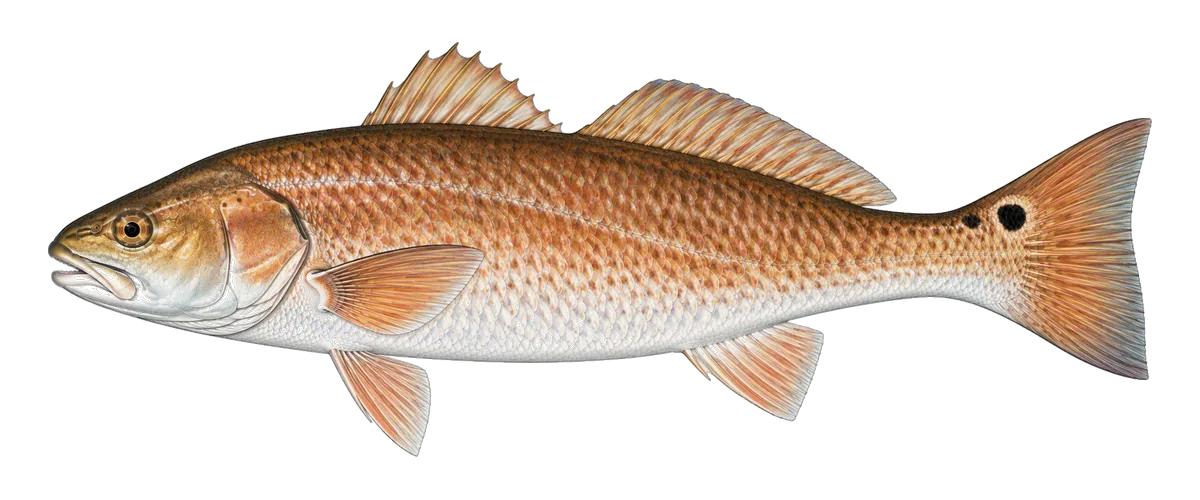
The best bait for redfish is whatever they're eating where you fish: live shrimp under a popping cork, a blue crab or fiddler crab on the bottom, or a finger mullet or mud minnow on a jighead. For the big ones, especially in the surf, fresh cut mullet, menhaden or half a blue crab is hard to beat. With lures, a gold weedless spoon, a soft plastic shrimp and a paddletail swimbait catch red drum from Texas to the Carolinas.
Below: what redfish eat through the year, each live and cut bait and how to rig it, the lures and how to work them, the surf and bull reds, and the rules in the states where people fish for them most.
What redfish eat
Redfish are bottom feeders built for crabs, shrimp and small fish. Their underslung mouth lets them root crabs out of the grass and mud, which is why you see them tailing in water so shallow their backs are out.
A 2023 study in Galveston Bay by Texas Parks and Wildlife biologists and Texas A&M University at Galveston found that red drum keep a balanced diet and eat what the season puts in front of them:
- In spring, small baitfish made up most of what was swimming in the bay: menhaden, croaker, pinfish, anchovies and spot. About 45% of red drum stomachs held fish, and brown shrimp made up most of the rest.
- In fall, shrimp and crabs were far more plentiful, and crabs showed up much more often in the fish they sampled. Fish still filled about 45% of stomachs.
A North Carolina study of younger red drum found much the same menu of blue crab, shrimp and juvenile menhaden, and that feeding peaked just after dark.
The practical upshot: bring a shrimp, a crab and a baitfish, and lean toward whichever is thick in the water that month.
Reds feed hardest around structure that holds that food: oyster bars, grass edges, marsh drains and the mud flats beside them.
The best live bait for redfish
Live shrimp
Shrimp is the most dependable redfish bait there is, and the easiest to buy. Hook it through the horn on its head and hang it under a popping cork over grass flats, along oyster bars and at the mouths of marsh drains. A shrimp has to be lively to work under a cork, so keep them in a well-aerated bucket and change a dead one out.
Without a cork, thread a shrimp onto a light jighead and bump it along the bottom, or hook it through the tail and pitch it to a tailing fish. Florida Sportsman's Mike Conner notes that a fresh-dead shrimp, threaded on the hook, works just fine.
Blue crabs and fiddler crabs
Crab is the bait redfish are built to eat. Small "bonefish" crabs under 3 inches across are ideal for flats reds. Fiddler crabs shine when wind, a full moon or a flood tide pushes water high into the grass and the fish follow it in. Fish them on a light egg sinker, a split shot or a small jighead, and drag them slowly along the bottom; a slow crawl also keeps crab baits from twisting your line.
For bull reds, a whole blue crab with a 4- to 5-inch shell, or half of a bigger one, is a top big-fish bait. If you plan to catch your own crabs, check your state's blue crab rules first.
Finger mullet and mud minnows
Small mullet are a year-round redfish staple, and in fall, when the mullet run pushes schools along the beaches and into the creeks, they're the bait to have. Carolina Sportsman's guides hook a mullet minnow on a 1/8- to 1/4-ounce jighead, through the bottom of the mouth and out the top, so it can be swum and bumped along the bottom. Small minnows suit small reds; bigger ones suit upper-slot and over-slot fish.
Mud minnows (killifish) are the spring standby in the Carolinas, when little other live bait is around. They're tough, they stay on the hook, and a jighead keeps them from burrowing into the mud.
Menhaden and pinfish
Live menhaden (pogies) and pinfish are big-fish baits. Fish them on a Carolina rig on slightly heavier tackle around passes, inlets and deep channel edges, where the larger reds feed.
Cut bait for redfish
Redfish rely on smell as much as sight, and fresh cut bait put on the bottom gets found. Chunks of mullet, menhaden, ladyfish or pinfish, or a crab cut in half, are the usual choices.
- Keep it fresh. A chunk cut that morning outfishes one that has sat in the sun all day.
- Fish it still. Cast it to a hole, a creek mouth or a trough, let it sit, and wait.
- Size it to the fish. A thumb-sized chunk for slot reds, a big steak of mullet or menhaden for bulls.
Cut bait is the go-to in two places especially: in the surf for big reds, and in winter, when cold fish won't chase anything.
How to rig bait for redfish
Most redfish bait rigs come down to three: a popping cork, a Carolina rig and a jighead.
Popping cork rig. A cork with beads or a clacker, a leader, and a hook or jighead with a shrimp or soft plastic. Sport Fishing magazine's guides fish it in about 2 to 6 feet of water. Set the leader so the bait hangs just above the grass, not in it. Use 15- to 20-pound fluorocarbon in clear water and 20 to 50 pounds in dark or dirty water. Pop the cork sharply with the rod tip, pause, and pop again; the noise draws fish and the bait drifting back down under the cork gets eaten. Skip it in strong current, where reds hug the bottom.
Carolina rig. A sliding egg sinker above a swivel, a foot or two of leader, and a circle hook. Use just enough weight to hold the bait in place; a rig that tumbles in the current snags up. It's the rig for finger mullet, mud minnows and menhaden around docks, rocks, creek mouths and channel edges.
Jighead. A 1/8- to 1/4-ounce jighead with a minnow, shrimp or soft plastic lets you cover water and feel the bottom.
Use circle hooks with bait. Redfish swallow quickly, and a J-hook with a long leader often ends up in the throat. A circle hook slides to the corner of the mouth and sets itself when the line comes tight. Don't jerk; just reel.
The best lures for redfish
Lures cover water to find the fish, and some days they outfish bait. Florida Sportsman's Mike Conner puts it plainly: there's no single best redfish lure, but a few styles catch reds everywhere they live.
Gold weedless spoon. The classic. Conner likes a 1/8-ounce weedless spoon for its quiet splashdown. Gold is the standard, but he found black better on clear, sunny days. Retrieve it slowly with a wobble, and use a snap swivel to keep it from twisting your line.
Soft plastic shrimp. Swim it slowly, snap the rod tip so it darts, then let it sink on a tight line. Most strikes come as it falls. Rig one under a popping cork, too: Sport Fishing magazine's top redfish setup was a jig and soft plastic under a cork.
Paddletail swimbait. A soft paddletail on a jighead imitates a mullet or menhaden and swims on its own with a steady retrieve. Bump it around oyster bars, potholes and channel edges. In cold water, slow-roll it so the tail barely kicks.
Soft jerkbait. A 3- to 5-inch soft jerkbait rigged weedless skips under mangroves and over grass. Twitch it on top or let it sink to the fish. Conner's pick is a Zoom Super Fluke in New Penny.
Topwater. A walk-the-dog plug at first light over shallow flats draws vicious strikes. Reds' downturned mouths make them clumsy at the surface, so keep the lure moving after a miss; they'll come back for it. Mash the barbs on the trebles for an easier release.
Crab imitations. A soft plastic crab or a crab fly dragged slowly along the bottom matches what fall reds are eating. Texas Parks and Wildlife's biologists suggest crab-style presentations and curly tails dragged slowly along the bottom in fall.
A Louisiana trick: a gold spoon under a cork. Capt. Ted DeAgano of Delacroix ties a 1/2- or 3/4-ounce weedless gold spoon about 8 inches below a popping cork on 40-pound mono, which sinks faster than fluorocarbon. The pop makes noise, the spoon flashes, and fish that come to the cork find the spoon right there.
If you also fish for snook along the same mangroves, the best bait for snook overlaps a lot with this list.
Best bait for redfish by season
Spring. Baitfish dominate the bays. Shrimp under a popping cork is the Texas biologists' spring pick, and mud minnows are the Carolina standby until finger mullet show up. Reds spread out over the flats as the water warms.
Summer. Fish early, late and at night, when it's cooler and reds feed hardest. Live shrimp, crabs and finger mullet all work; topwater at first light.
Fall. The best redfish season in much of the South. Shrimp and crabs are everywhere, the mullet run pushes bait along the beaches and into the creeks, and reds feed hard ahead of winter. Bull reds gather near inlets and along the beaches to spawn, in the Carolinas especially in September and October. Fish crabs, finger mullet and crab-style lures.
Winter. Cold reds slow down and school up. Look for them on dark mud flats and in sheltered marsh ponds, which hold the sun's warmth, often best on a sunny afternoon after the low tide has let the mud heat up. Slow everything down. Salt Water Sportsman's winter guides fish lures "very slow and deliberate," favor dark jigs worked along the bottom, and note that reds will sometimes pick a still lure off the bottom before they'll chase a moving one. Fresh-dead shrimp, cut bait and mud minnows on a jighead all work.
Every spot has its own best tide and season, and you learn them by keeping track. Taklbox saves each catch with its bait, tide, moon and barometer reading, so after a season you can see what your spots have in common.
Best bait for redfish in the surf (and bull reds)
Big adult red drum, the "bulls," cruise the surf and gather near inlets in late summer and fall. They are surf fishing's main event from Texas to the Outer Banks.
Bait: fresh cut mullet or menhaden, a big chunk at a time, or a whole or half blue crab. Bait thieves will pick small pieces apart.
Rig: a fish-finder rig: a 3- to 6-ounce pyramid sinker on a slide above a heavy swivel, 18 to 24 inches of fluorocarbon leader and a big circle hook, with the rod in a sand spike. In the Southeast, many guides now use a short-leader rig from the Fish Smart Red Drum Conservation Project: a 10-inch, 80-pound mono leader with the sinker no more than 6 inches from an inline circle hook. Sport Fishing magazine explains that a bull red hesitates to swallow past the weight, and the hook finds the corner of the mouth instead of the throat.
Release them well. Most bulls go back; in much of the Southeast and Mid-Atlantic, adult red drum can't be kept, so check the rules below. Follow FWC's handling advice:
- Use heavy enough tackle to land the fish quickly.
- Keep it in the water, or out only briefly for a photo, and support its belly; never hold a big fish up by the jaw alone.
- Hold it upright in the water until it can swim off on its own.
Snap a photo before you let it go: on iPhone Pro models, Taklbox measures the fish's length from the picture, so the release still goes in your log.
Redfish rules in Florida, Texas, Louisiana and the Carolinas
Every state that has red drum manages them with a slot, so the small ones and the big spawners go back. The cards below come straight from the data Taklbox checks your catch against, with each state's official link. Florida draws its rules by region, and its Indian River Lagoon is catch-and-release only.
Texas has a red drum tag for one fish over the slot each license year, and its card includes the two freshwater lakes near San Antonio, Braunig and Calaveras, where red drum live in fresh water.
South Carolina changed its red drum rules on July 1, 2026. If you learned the old numbers, check the card.
Not sure whether the red you're holding is legal where you caught it? Snap it: Taklbox names it, measures it on iPhone Pro models, and checks the slot, bag and season where you caught it. It has red drum rules on file for 13 states.
Frequently asked questions
What is the best bait for redfish and speckled trout?
Live shrimp under a popping cork catches both, often from the same spot. For lures, a soft plastic shrimp or a paddletail on a light jighead works for both; trout tend to sit a little higher in the water than reds.
What is the best bait for redfish in the surf?
Fresh cut mullet or menhaden, or half a blue crab, on a fish-finder rig with a circle hook. Fish the troughs and the ends of sandbars, especially near inlets in the fall.
What is the best bait for bull redfish?
A whole or half blue crab, or a big chunk of fresh mullet or menhaden, fished on the bottom with a short-leader circle hook rig. Bulls are usually catch-and-release, so land them fast and keep them wet.
Do redfish bite at night?
Yes. Research on young red drum in North Carolina found their feeding peaked just after dark. Lighted docks, bridges and creek mouths on a moving tide are good bets.
What color lure is best for redfish?
Gold is the classic for spoons. Black shows up better on clear, sunny days and in muddy water, and dark jigs are a winter favorite. When in doubt, match the shrimp and baitfish where you're fishing. For more on what to tie on, see the rest of the bait and lure guides.