The best topwater for redfish is a small walk-the-dog plug, like a Heddon Super Spook Jr. or a Rapala Skitter Walk, in bone or another light color, worked steadily over shallow grass flats and grass edges early and late in the day. Fall is prime, especially on a falling tide as water drains out of the grass. A red's mouth sits low on its head, so it misses a lot of plugs: keep the lure moving after a blowup, and don't set the hook until you feel the fish's weight.
Below: why redfish miss topwaters, the plugs that work, when and where to throw them, how to work one, the hookset, colors, tackle, topwater flies, and the rules.
Why redfish miss topwater lures
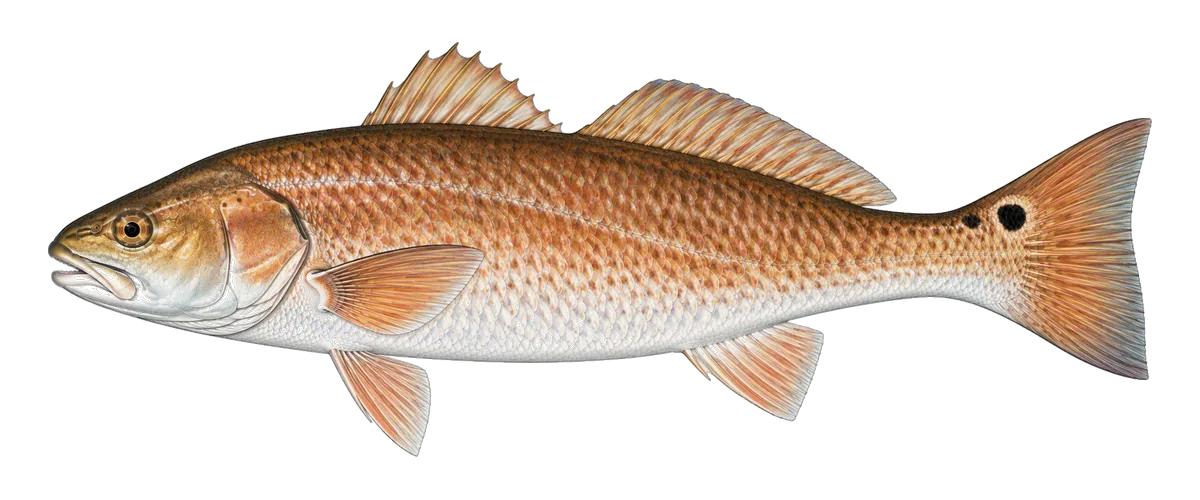
A redfish is built to feed on the bottom. Its mouth sits low on its head and opens downward, so to eat something on the surface, a red has to get its head above it. Carolina Sportsman's Bryan Bowers puts it plainly: a red has to position its head above what it's after to get it in its mouth.
Salt Strong's Wyatt Parcel adds that a red often has to come up from behind a plug and strike down on it, which is why so many redfish blowups don't connect. The good news: a red that misses usually isn't spooked. Bowers finds a redfish will double back and take another swipe or two, so keep working the lure instead of reeling in to recast.
The best topwater lures for redfish
Small walking plugs. The walk-the-dog plug is the standard, and smaller is often better for reds. Salt Strong's Luke Simonds prefers the Super Spook Jr. for mixed trips of redfish and trout, because reds have a tougher time taking down the full-size plug. Bowers lists the Super Spook Jr. and the Rapala Skitter Walk among his fall redfish plugs.
Poppers. A cupped-face popper throws more water and noise in one spot, which helps a red find it in a chop or stained water. Work it with short pops and pauses.
Suspending twitchbaits worked on top. Parcel passes along a trick credited to Jay Watkins Jr.: work a soft-bodied Corky or Paul Brown Fat Boy like a topwater, with a walk-the-dog action, and it stays right at the surface. Because it rides lower than a hard plug, reds can get it in their mouths more easily. Parcel uses it early in spring, when reds hesitate to hit hard topwaters. Bowers does something similar with a MirrOdine, working it so it runs just 3 or 4 inches under the surface.
When to throw a topwater for redfish
- Low light. Bowers finds early and late, when the sun is low, consistently the best time.
- Fall. Reds feed hard in the fall, when bait is thick in the marsh and on the flats.
- A falling tide. Bowers likes the middle of the falling tide for hard baits, when water is flowing out of the grass and carrying bait with it. For more on tides, see the best tide for redfish.
- Warm water, and clouds. Salt Strong ties the topwater bite to warming water in spring and summer, and Parcel finds an overcast sky can stretch the bite through the day.
- Cold water calls for slow. In cold water, with sluggish fish, slow the plug down.
Every red you catch on top is a clue to the next one. Taklbox saves each catch with its place, bait, tide, moon and barometer reading, so you can see what your best topwater mornings had in common.
Where to throw a topwater for redfish
- Grass flats and grass edges, where the water drains out on the falling tide.
- Tailing and cruising fish. A red pushing a wake or tailing in shallow water will often turn on a plug landed a few feet ahead of it.
- Schools on the flats. Fan-cast: Salt Strong suggests moving each cast 5 to 8 feet to the side of the last to cover the water.
- Over oyster bars and along shorelines in shallow water, where a plug rides over cover that would foul a jig.
How to work a topwater for redfish
- Keep the rod tip low and to the side, and twitch it straight back.
- Reel just enough to take up the slack between twitches, so the plug zigzags.
- Keep it moving. Bowers finds a steady crankbait-style retrieve draws few strikes; the twitching walk is what makes reds commit.
- After a miss, keep going. Salt Strong's topwater guide, built around North Carolina guide Capt. Jud Brock's approach, says to keep the plug moving at the same pace or even speed it up after a redfish blows up, rather than pausing it the way you would for trout.
- Fish it all the way back. Reds and trout often follow a plug right to the boat.
If they keep missing, throw a soft plastic or a suspending twitchbait right where the fish blew up. You know where it is now.
Setting the hook on a topwater redfish
Don't set the hook on the splash. Charleston guide Capt. John Irwin finds anglers tend to set the hook too quickly and pull the lure away from the fish. Salt Strong's rule is the same: don't set the hook until you feel the fish on your line. Wait for the weight, or at least until the plug disappears, then sweep the rod and reel.
Best topwater colors for redfish
- Bone. If you can only carry one, Parcel's pick is bone, and Simonds calls it tough to beat for redfish.
- Darker in low light, lighter in bright light. Bowers changes color with the light: dark plugs at dawn and dusk, when they show a clear silhouette, lighter ones when it's brighter.
- Match the bait. A white or silver plug looks like a finger mullet; a tan or gold one, more like a shrimp.
Topwater tackle for redfish
- Rod: Bowers fishes a 7- to 7½-foot medium spinning rod or medium-heavy casting rod.
- Line: 20-pound braid, which casts far and makes the twitches crisp.
- Leader: 30- to 40-pound monofilament. Bowers prefers mono to fluorocarbon for topwaters: the stiffer leader keeps the line from fouling on the trebles, and fluorocarbon sinks and drags the nose of the plug down.
- Knot: a loop knot lets the plug swing freely. Simonds recommends the non-slip loop knot for the Super Spook Jr.
Topwater flies for redfish
Redfish eat surface flies too, and a fly that lands softly can fool a red that would spook from a plug.
- The gurgler. Aaron Adams, writing in MidCurrent, makes it his surface fly of choice because it's light, casts well and lands softly. A weedless version, tied to ride hook-up, fishes over the thick grass that a sinking fly would foul. He ties it in tan to look like a shrimp or small flatfish, and white to look like a finger mullet and show up at dusk.
- Surface shrimp flies on flood tides. In the flooded marsh grass, Irwin gives a shrimp fly a couple of pops and then lets it sit still, especially for tailing fish.
- The hookset: Adams keeps stripping the same way that drew the strike and strip-strikes when he feels the fish, rather than lifting the rod, which pulls the fly away and leaves the red circling.
He fishes a long leader, 10 to 12 feet, so the fly line doesn't spook the fish, and casts past a cruising red so the fly comes back across its path.
Redfish rules
Topwaters catch plenty of reds that are too small or too big to keep. Most states manage redfish with a slot, and Florida sets its rules by region. The cards below show three states, from the data Taklbox checks your catch against, with the official links. Every state is in the redfish size limits by state.
Snap the red and Taklbox names it, measures it on iPhone Pro models, and checks the size, bag and season where you caught it.
For the trout side of the same flats, see the best topwater for speckled trout, and for the rest of the redfish lure box, the best bait for redfish.
Frequently asked questions
Do redfish hit topwater lures?
Yes, especially in fall and in low light over shallow grass. Their low-set mouths make them miss more often than trout, so keep the plug moving and wait to feel the fish before you set the hook.
What is the best topwater color for redfish?
Bone is the standard. Use darker plugs at dawn, dusk and under clouds, and lighter ones in bright light.
Why do redfish keep missing my topwater?
A redfish's mouth faces down, so it has to rise and come down on a surface plug, and it often misjudges. Keep the plug moving after a miss, and don't set the hook until you feel the fish. A suspending twitchbait worked just under the surface is easier for a red to eat.
What are the best topwater lures for redfish and trout?
A small walking plug like the Super Spook Jr. or Skitter Walk catches both. Keep it moving for reds, and add pauses for trout.
When should I throw a topwater for redfish?
Early and late in the day, on a falling tide when water drains off the grass, and in the fall, when reds are feeding hard on bait in the shallows.