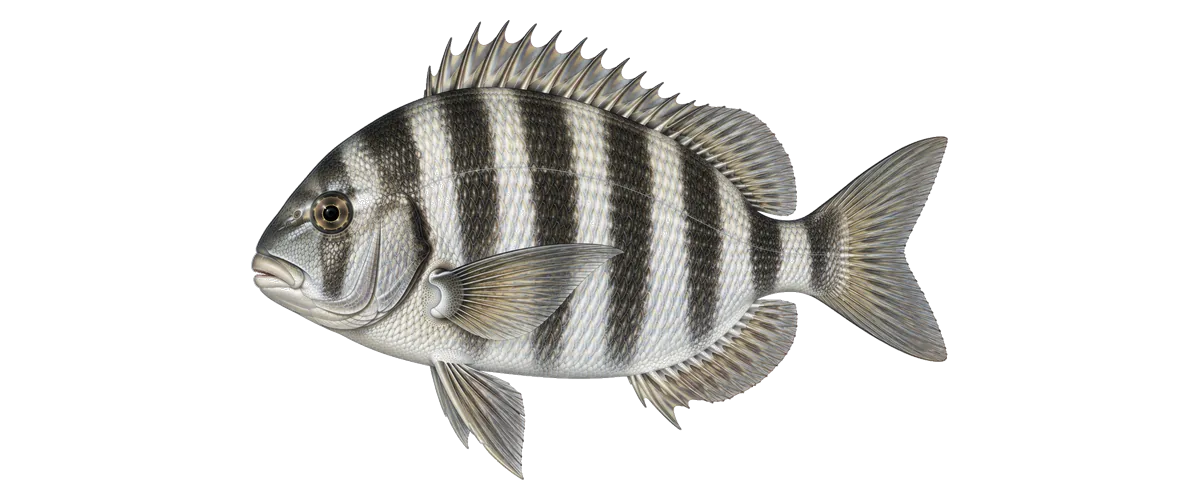
To tell a black drum from a sheepshead, look at the chin and the teeth. A black drum has a fringe of small barbels under its lower jaw and no teeth in the front of its mouth; it crushes shells with plates in its throat. A sheepshead has no barbels and a mouth full of teeth that look like a person's, with incisors in front and molars behind, plus strong, sharp spines on its back. The stripes won't settle it on a small fish, because young black drum have dark bars too; they fade as the drum grows, while a sheepshead keeps its bars for life.
Below: the differences side by side, the teeth up close, how big each gets, where they live and what they eat, when they spawn, how to catch each one, which tastes better, and the rules.
Black drum vs sheepshead at a glance
| Black drum | Sheepshead | |
|---|---|---|
| Chin | A fringe of small barbels | Smooth, no barbels |
| Front teeth | None; crushing plates in the throat | Broad, human-like incisors |
| Spines | Ordinary | Strong, sharp dorsal and anal spines |
| Bars | Four to six on young fish, fading with age | Five to seven, for life |
| Background color | Gray to black, sometimes bronze | Light gray to white |
| Family | Drums | Porgies |
| Grows to | About 67 inches and over 100 pounds | About 36 inches and 20 pounds |
| On the table | Good when small; big ones turn coarse | Excellent |
The details, and where each comes from, are below.
How to tell a black drum from a sheepshead
Look under the chin
FWC lists the black drum and the sheepshead as look-alikes, and the chin is the quickest way to tell them apart. A black drum has barbels on its lower jaw; the Virginia Institute of Marine Science counts 10 to 13 pairs of small ones. Black drum of every size have them, and Texas Parks and Wildlife says they use them to find food by feel and smell. A sheepshead's chin is smooth, with no barbels at all.
Open the mouth
FWC's other difference: a black drum lacks incisor-like teeth. A sheepshead has prominent ones, along with molars and rounded grinders. Louisiana State University's Sea Grant program says any confusion can be set aside by inspecting the teeth, which look a great deal like human, or sheep, incisors.
Mind the spines
A sheepshead's dorsal and anal fins carry strong, sharp spines, FWC notes; South Carolina's Department of Natural Resources counts twelve in the dorsal fin, with a notably strong second spine in the anal fin. Grab a sheepshead carelessly and you'll know it. Use a towel or a fish grip.
Count the bars, and check the fish's size
Both can wear dark vertical bars, which is why small black drum get mistaken for sheepshead.
- Sheepshead carry five or six dark bars on a gray body, plus one on the nape, by South Carolina DNR's count; LSU counts five to seven wide, grayish-black bars on a light gray or white background. They keep them all their lives, which is where the nickname "convict fish" comes from.
- Black drum wear four or five bars, up to six by FWC's count, only while they're young; Texas Parks and Wildlife says they're typical of fish under about a foot long. As a drum grows, the bars fade and the fish turns gray to black, sometimes with a bronze tint.
So a big barred fish is a sheepshead. A small barred fish could be either: check the chin.
Compare the shape
Both are deep-bodied, but a black drum has a high, arched back and a downturned mouth set low under its head for rooting on the bottom. South Carolina DNR describes the sheepshead as nearly oval.
Watch for a third look-alike
FWC also lists the Atlantic spadefish as a sheepshead look-alike. It's another barred, deep-bodied fish around structure, but like the black drum, it lacks the sheepshead's incisor-like teeth.
Still not sure, or the fish won't hold still? Snap a photo. Taklbox names the species on the phone itself, so it works on the water with no signal.
Black drum vs sheepshead teeth
Both fish crunch shellfish for a living, but they do it with different tools.
- Sheepshead do the work in the front of the mouth. South Carolina DNR describes four broad, incisor-like teeth on each side of the front jaw, with several molar-like teeth behind them. The incisors scrape barnacles and oysters off pilings and rocks; the molars crush them.
- Black drum have no teeth to speak of in the front of the mouth. They feel for buried clams and oysters with their barbels, suck them up and crush the shells with heavy plates in the throat.
That's also why the two bite so differently. A sheepshead nibbles and scrapes, and steals bait cleanly. A black drum tends to mouth a bait for a while before it swallows it.
How big black drum and sheepshead get
Black drum grow far bigger. FWC lists them to 67 inches, and the heaviest black drum registered by the International Game Fish Association weighed 113 pounds, Texas Parks and Wildlife notes. Most of the big "bull" drum anglers catch weigh 30 to 40 pounds.
Sheepshead top out at about 36 inches, FWC says, and are common around 13 inches. LSU puts them at 2 to 8 pounds commonly, with fish to 20 pounds. Florida's state record weighed 15 pounds 2 ounces, and South Carolina's 16 pounds 6 ounces. Sheepshead can live to about 20 or 25 years.
Where they live and what they eat
You'll often find the two on the same structure.
Sheepshead live around hard structure: reefs, wrecks, piers, pilings, rocks and jetties, South Carolina DNR says, and oyster bars, seawalls and tidal creeks, FWC adds. They eat mussels, clams, small oysters, barnacles, crabs, shrimp and small fish. LSU, summing up their diet, says simply that they eat everything; in a Lake Pontchartrain study, more than half their diet by volume was plants.
Black drum live in bays, river mouths and lagoons, often around oyster beds, docks and bridge pilings, and some live offshore. Texas Parks and Wildlife calls them more adaptable than any other important Texas food fish, at home from clear sand flats to muddy sloughs. They eat oysters, mussels, clams, crabs and shrimp.
Both feed around oyster bars. Taklbox Pro marks mapped oyster beds on the map, the structure both fish work.
When black drum and sheepshead spawn
Both spawn in late winter and spring, which is why both are winter and spring fish around jetties and passes.
- Sheepshead spawn from February through April, LSU says, with most spawning in the last two months. FWC notes they spawn a portion of their eggs at a time, typically in March and April. South Carolina DNR finds they spawn nearshore and offshore, probably near wrecks, reefs and live bottom, and that they gather in shallow water in late spring, and again in late fall and early winter as they move between inshore and nearshore waters.
- Black drum gather in big spawning schools around passes, jetties and bay mouths in late winter and spring. Texas Parks and Wildlife notes you can sometimes hear a school drumming near the boat.
How to catch black drum and sheepshead
Sheepshead feed tight to structure, so fish right against the pilings, rocks and jetty stones. FWC's advice: live shrimp, sand fleas or fiddler crabs on a small hook fished on the bottom. Fresh oysters and barnacles scraped from the structure work too. They steal bait cleanly, so keep slack out of the line, use a short, strong hook, and set it at the faintest tap.
Black drum feed mostly by feel and smell, and Texas Parks and Wildlife says they're rarely taken on artificial baits unless they're scented. Fish peeled shrimp, crab or clams on the bottom, and give the fish time to take it. See the best bait for black drum.
Black drum vs sheepshead: which tastes better?
Sheepshead, most anglers would say. LSU calls them excellent eating, with a warning: clean them carefully, because of the sharp spines, and FWC adds the sharp gill covers.
Black drum are good eating when small. Fish over about 15 pounds turn coarse, and big black drum often carry "spaghetti worms," the larvae of a tapeworm, in their flesh. LSU Sea Grant notes the worms are harmless to people when the fish is cooked, but most anglers release the big drum and keep the small ones to eat. For more on that, see red drum vs black drum.
Black drum and sheepshead rules
Each state sets its own rules for both fish, and they're different for each one, so it matters which you have. Note how each rule measures: a couple of states measure sheepshead by fork length. The cards below are from the data Taklbox checks your catch against, each with the official link.
Florida
Texas
North Carolina
South Carolina
Virginia
Snap the fish and Taklbox names it, measures it on iPhone Pro models, and checks the size, bag and season where you caught it.
Frequently asked questions
How do you tell a juvenile black drum from a sheepshead?
Check the chin. Both can wear dark vertical bars, but a young black drum has small barbels under its lower jaw and no front teeth, while a sheepshead has a smooth chin and human-like incisors.
Do black drum have teeth?
Not in the front of the mouth. They crush clams, oysters and crabs with heavy plates in the throat. Sheepshead have the front teeth, incisors and molars that look like a person's.
Which tastes better, black drum or sheepshead?
Sheepshead, by most anglers' reckoning, and LSU Sea Grant calls them excellent. Small black drum eat well too; big ones are coarse and often wormy.
Are sheepshead and black drum related?
Not closely. The sheepshead is a porgy; the black drum is a drum, in the same family as the red drum and speckled trout.
Why is a sheepshead called a convict fish?
For its black-and-white bars, which look like an old-fashioned prison uniform.