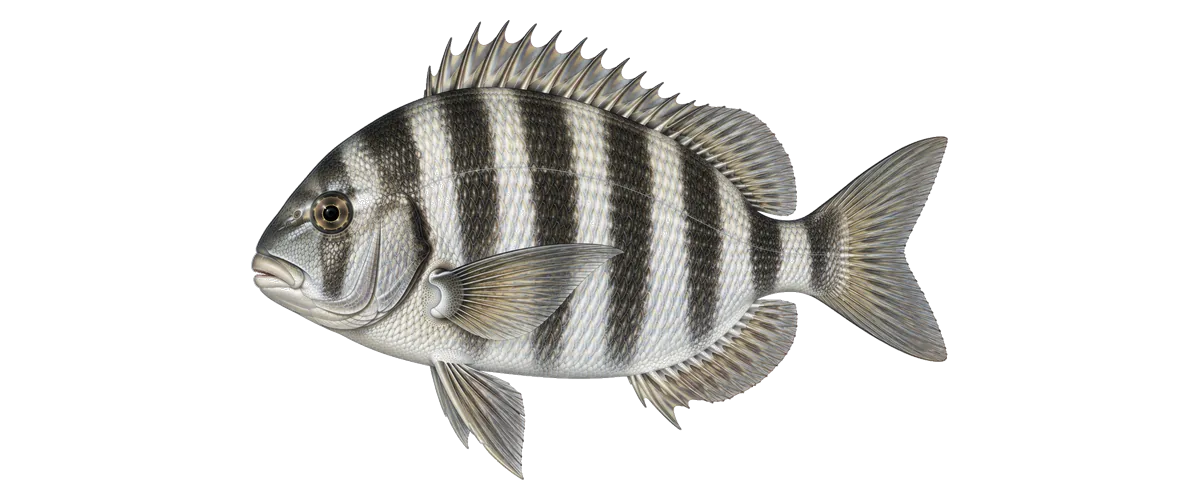
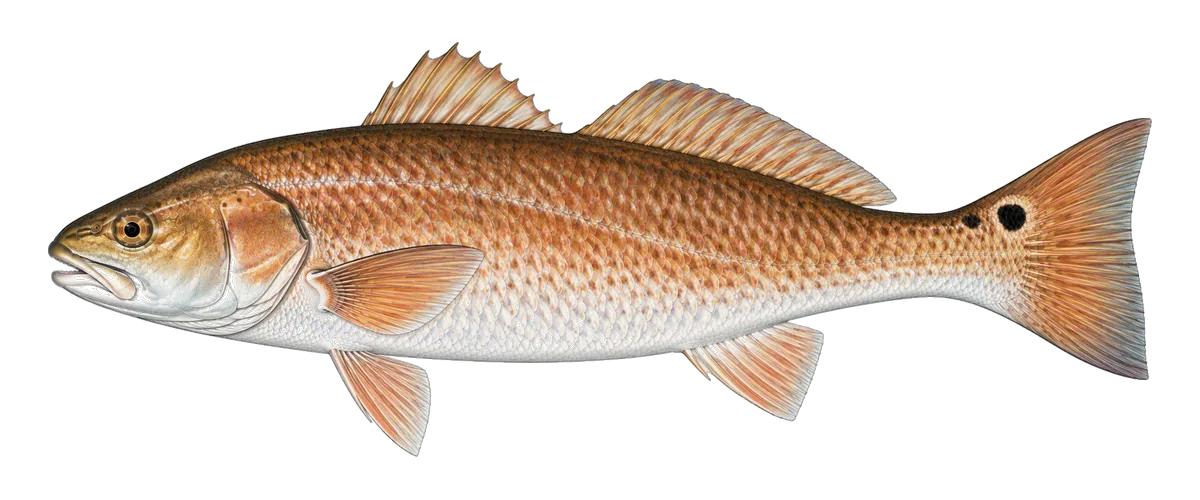
To tell a red drum from a black drum, look under the chin, then at the tail. A black drum has a fringe of short, whisker-like barbels under its lower jaw and no spot on its tail. A red drum (redfish) has a smooth chin and at least one black spot at the base of its tail. Black drum are also taller in the back and gray to black, and young ones wear four or five dark vertical bars.
Below: the two side by side, each difference in detail, what they eat and where they live, which one is better to eat, the rules in Florida and Texas, and whether the two ever cross.
Red drum vs black drum at a glance
| Red drum | Black drum | |
|---|---|---|
| Chin | Smooth, no barbels | 10 to 13 pairs of short barbels |
| Tail | One or more black spots at the base | No spot |
| Body | Longer and lower-backed | Short, deep, with a high arched back |
| Color | Usually copper-bronze; can run from nearly black to nearly silver | Gray to black; silvery in the Gulf, sometimes with a bronze tint |
| Young fish | Tail spot, no bars | Four or five dark vertical bars |
| Main food | Crabs, shrimp and small fish | Oysters, clams, mussels, crabs and shrimp |
| Spawns | Late summer and fall | Late winter and spring |
| Grows to | About 61 inches | About 67 inches |
| On the table | Good eating | Good when small; big ones turn coarse |
The details, and where each one comes from, are below.
How to tell red drum and black drum apart
Look under the chin
Black drum have barbels; red drum don't. FWC lists red drum and sheepshead as the black drum's look-alikes, and the barbels on its lower jaw as what sets it apart from both. The Virginia Institute of Marine Science counts 10 to 13 pairs of small barbels along the lower jaw.
Black drum of every size have them, Texas Saltwater Fishing Magazine notes, and Texas Parks and Wildlife says they use them to find food by feel and smell. The genus name, Pogonias, means "bearded." Between these two fish, the chin settles it.
Check the tail for a spot
A red drum has one or more black, eye-like spots near the base of the tail. Texas Parks and Wildlife says one spot is typical, several aren't unusual, and a red with no spot at all is extremely rare. The agency suggests the spot may draw a predator's strike to the tail instead of the head.
A black drum has no tail spot. A redfish speckled with a dozen spots is still a redfish.
Compare the body shape
Black drum are chunky and high-backed, with a back FWC describes as highly arched. Red drum are longer and lower in the back. Side by side, a black drum looks like a red drum someone squeezed from both ends.
Don't go by color
Color overlaps more than the names suggest. Texas Parks and Wildlife says red drum run from a deep blackish copper to nearly silver, with reddish-bronze the most common, and North Carolina's Division of Marine Fisheries describes them as silvery-gray with a coppery cast. Black drum range from black to gray, sometimes with a bronze tint. Fish from Gulf waters are usually light gray or silvery, and fish from the bays darker.
A dark, coppery red and a bronze-tinted black drum from a muddy bay can look surprisingly alike. Go by the chin and the tail.
The mouth won't help
Both fish have what biologists call an inferior mouth: set low under the head and opening downward, built for rooting food off the bottom. North Carolina's description of the red drum and VIMS's description of the black drum both use the term. Both also feed head-down on the bottom, which anglers call tailing, and in shallow water you'll often see the tail break the surface.
Young black drum have stripes
Young black drum wear four or five dark vertical bars, which fade as the fish grow. FWC says there can be up to six, and Texas Parks and Wildlife says they're typical of fish under about a foot long. Young red drum have no bars, just the tail spot.
The bars get small black drum mistaken for sheepshead, which FWC lists as a look-alike. Check the chin again: a sheepshead has no barbels.
Still not sure, or the fish won't hold still? Snap a photo. Taklbox names the species on the phone itself, so it works out on the water with no signal.
How big red drum and black drum get
Black drum grow bigger. FWC lists black drum to 67 inches and red drum to 61. The heaviest black drum registered by the International Game Fish Association weighed 113 pounds, Texas Parks and Wildlife notes, against a 94-pound red drum from the North Carolina coast. Most of the "bull" black drum anglers catch weigh 30 to 40 pounds, and black drum under a pound are sometimes called "butterfly drum."
Red drum grow faster while they're young. By Texas Parks and Wildlife's figures, a two-year-old redfish is about 17 to 22 inches long, while a black drum the same age is about a foot.
Both fish "drum," vibrating muscles against the swim bladder to make the sound that gives the family its name. Texas Parks and Wildlife says the ability is most developed in the black drum, and that anglers can sometimes hear a school passing near the boat.
What red drum and black drum eat
Both are bottom feeders with heavy crushing teeth in the throat, so their menus overlap. The difference is emphasis.
Black drum are shellfish specialists. FWC lists oysters, mussels, crabs and shrimp; Texas Saltwater Fishing Magazine adds clams. They feel for buried prey with their barbels, dig it out head-down, and crush the shells in their throat.
Texas Parks and Wildlife says the feeding leaves small craters in the bottom that anglers call "drum noodles." Texas Saltwater Fishing Magazine notes that the two drums probably compete for food on the bottom, with the black drum's stronger throat teeth giving it the edge on shellfish.
Red drum eat more crabs, shrimp and fish. Young reds eat small crabs, shrimp and marine worms. Bigger ones take larger crabs, shrimp and small fish such as mullet, pinfish and croaker. They feed mostly on the bottom but will rise to feed higher in the water when the chance comes, Texas Parks and Wildlife says.
That difference shows up on the end of your line:
- Red drum hit lures readily: spoons, paddletails, soft plastic shrimp and topwater plugs. See the best bait for redfish.
- Black drum are "rarely taken on artificial baits (unless they are scented)," Texas Parks and Wildlife says, because they feed mostly by feel and smell. Peeled shrimp, crab, clams and cut bait on the bottom are the standard. Drum often mouth a bait for a while before they swallow it, so give them time. See the best bait for black drum.
The cards above show Taklbox's top three baits for each fish. In the app, every species has a profile, and the top baits are in Taklbox Pro.
Where you find red drum and black drum
The two share a lot of water: the same bays, oyster bars, docks, jetties and passes. Where they differ is how far each one ranges.
Red drum favor shallow water, about 1 to 4 feet deep, along bay edges with seagrass, according to Texas Parks and Wildlife. They also work soft mud, oyster reefs, points, jetties and the guts between bars. During cold spells they crowd into tidal creeks and rivers, and they can live in fresh water many miles upriver. FWC says young reds stay inshore for about their first four years, then join the adults in nearshore waters.
Black drum live in bays, river mouths and lagoons, often around oyster beds, docks and bridge pilings, FWC says, and some live offshore. Texas Parks and Wildlife calls them more adaptable than any other important Texas food fish: from clear sand flats to muddy sloughs, and from very shallow water to Gulf water deeper than 100 feet. They're drawn to freshwater runoff, yet can live in water about twice as salty as the Gulf.
In summer, schools of small black drum feed in shallow water and leave a telltale patch of muddy water behind them. In the colder months, drum of all sizes move to deeper channels and the surf.
Both fish feed around oyster bars, and black drum eat the oysters themselves. Taklbox Pro marks mapped oyster beds on the map.
When red drum and black drum spawn
The two spawn at nearly opposite times of year, which is why the big fish of each show up in different seasons.
Red drum spawn in late summer and fall. FWC puts the season at about August through December, in passes, inlets and lagoon estuaries. Texas Parks and Wildlife puts it from mid-August to mid-October in the Gulf near pass mouths and shorelines. That's when bull reds gather on the beaches and around inlets; see where redfish go in the fall.
Black drum spawn in late winter and spring. FWC says nearshore in winter and early spring. In Texas, spawning runs mostly February through April, with some in June and July. Unlike Texas red drum, which spawn in the Gulf, black drum there can spawn in the bays as well.
Big black drum school up in bays, around jetties and in channels before they spawn, and Texas Parks and Wildlife singles out the bull drum runs of February and March.
Red drum vs black drum taste: which is better to eat?
Both are good eating at the right size, and size matters more than species. A slot redfish and a black drum of a few pounds are both fine table fish. A big black drum turns coarse.
Red drum. FWC says it plainly: "Redfish make great table fare." Red drum were popular enough on the plate that the blackened redfish craze, which started in Louisiana, sent demand for fillets soaring in the 1980s. Texas Parks & Wildlife magazine recounts how commercial purse seiners then went after the offshore spawning schools that restocked the bays.
That crash, and the long fight to rebuild the stock, is why red drum are managed so tightly today. Most states protect the big spawners, so the eating question is really about slot fish.
Black drum. Texas Parks and Wildlife says many anglers consider black drum under about 5 pounds, cleaned properly, as good as or better than the so-called choice fish. The flesh is white and firm, and neither dry nor oily. The agency's black drum guide suggests rolling fillets in cornmeal and frying them, and says serious drum anglers save the throat, which they consider the best part. Fish caught in cold weather before spawning are fatter than summer fish.
Over about 5 pounds, the agency says, the flesh turns coarse, and the bigger the fish, the coarser it gets. It encourages releasing large drum.
About the worms. Larger black drum can carry "spaghetti worms," which Texas Parks and Wildlife calls unappetizing but not harmful. A Louisiana Sea Grant fact sheet explains that they are larval tapeworms whose adult stage lives in sharks, that no human infections have been recorded, and that cooking kills them. In black drum they're most common near the tail, and you can pull one out by pinching it between a knife blade and your thumb.
How close are the two at the same size? In a 1994 study in the Journal of the World Aquaculture Society, researchers raised red drum, black drum and a hybrid of the two together in ponds for nine months. A taste panel couldn't find a difference in flavor between the three.
Red drum and black drum rules in Florida and Texas
Both states manage both fish with a slot, which protects the small ones and most of the big spawners. The cards below come straight from the data Taklbox checks your catch against, with each agency's official link.
Florida draws its red drum rules by region, and the Indian River Lagoon is catch-and-release only.
Florida's black drum rule is the same statewide.
Texas has a red drum tag for one fish over the slot each license year, and its red drum card includes Braunig and Calaveras, two lakes near San Antonio where red drum live in fresh water.
For red drum in the other Gulf and Atlantic states, see redfish size limits by state.
Not sure which drum you're holding, or whether it's legal where you caught it? Snap it: Taklbox names it, measures it on iPhone Pro models, and checks the slot, bag and season where you caught it.
Can red drum and black drum hybridize?
Yes, in a hatchery. The 1994 aquaculture study above crossed a female black drum with a male red drum. The hybrids grew faster than either parent.
In the wild, a cross is rare at best, because the two spawn at different times of year. Salt Water Sportsman reported a suspected hybrid caught on fly in Florida's Indian River Lagoon. It was bronze like a red drum with no tail spot, carried faded black bars like a black drum, and was built somewhere between the two.
Mike Tringali, a senior research scientist at the Florida Fish and Wildlife Research Institute, said red drum may spawn inside the lagoon, where some adults live year-round. A late-spawning red meeting an early black drum is one explanation. The fish was released before anyone took the fin clip a DNA test would have needed, so it was never confirmed.
Frequently asked questions
Do black drum have spots?
No. Black drum have no spot on the tail. Young ones have four or five dark vertical bars instead, which fade as they grow. A drum with a black tail spot and a smooth chin is a red drum.
Do all red drum have spots?
Nearly all. Most have one black spot at the base of the tail, and several aren't unusual, but Texas Parks and Wildlife says a red drum with no spot is extremely rare. If it has no spot, check the chin for barbels before calling it a black drum.
Is red drum or black drum better to eat?
Most anglers would pick a slot redfish, and FWC calls redfish great table fare. Texas Parks and Wildlife says many anglers rate black drum under about 5 pounds as good as the so-called choice fish; it's the big black drum that turn coarse and wormy.
How do you tell a young black drum from a sheepshead?
Check the chin. Both wear dark vertical bars, but only the black drum has barbels. A sheepshead's chin is smooth.
Are red drum and black drum related?
Yes. Both belong to the drum family, along with Atlantic croaker and spotted seatrout, and both make the drumming sound the family is named for. The black drum is the only species in its genus, Louisiana Sea Grant notes. For more on the fish themselves, see the rest of the Taklbox species guides.