The best bait for black drum is a crab, a clam or a fresh shrimp, fished on the bottom. Half or a quarter of a blue crab is the top bait for big drum at jetties, passes and bridges. Fresh dead or peeled shrimp is the dependable bait for smaller "puppy" drum around docks and oyster bars, and shucked clam is the standard in the Chesapeake and Delaware Bay. In the surf, add sand fleas. Black drum find their food by smell and touch, so fresh beats frozen and a bait off the bottom gets ignored.
Below: each bait and how to rig it, the fish-finder and knocker rigs, where to fish, the spring runs from Texas to New Jersey, and the rules in the states where people fish for them most.
What black drum eat
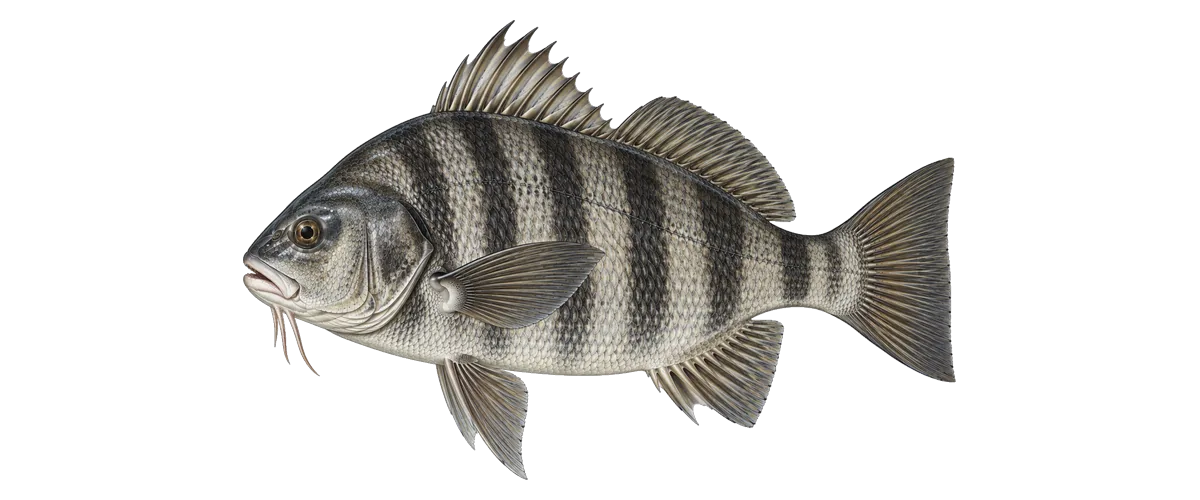
Black drum are built to feed on the bottom. The barbels on their chin feel for food in the mud and sand, and strong teeth in their throat crush shells, North Carolina's Division of Marine Fisheries says. The menu is oysters, clams, mussels, crabs and shrimp, plus worms and the odd small fish. Louisiana Sea Grant says young drum start on worms and small fish and switch to shellfish as they grow; drum from 1 to 10 pounds, which anglers call "puppy drum," are the most common.
The practical upshot: bring crab, shrimp and clam, keep it fresh, and keep it on the bottom. FWC's black drum profile stresses that last point, and N.C. Marine Fisheries adds that black drum are rarely caught on lures, unlike their cousin the redfish. If you're not sure which drum you're holding, see red drum vs black drum.
Drum feed where shellfish grow: oyster bars, barnacle-crusted bridge pilings, rock jetties and shell bottom along the channels.
The best bait for black drum
1. Blue crab
Blue crab is the bait for big black drum from Texas to Virginia. Cut it in half or in quarters, crack the shell so the juice scents the water, and leave it on the bottom. Florida Sportsman's Capt. Matt Chipperfield fishes crab chunks on a knocker rig with a circle hook: a heavier rig in deep, moving water and a lighter one on shallow flats.
Joe Richard, writing in Texas Saltwater Fishing Magazine, buys the biggest, liveliest crabs from a seafood dealer and leaves the circle hook's point fully exposed, so it sets in the drum's lip and not in the shell.
- Cold water: half a crab lasts a long time on the hook, one reason late winter is crab season for big drum.
- Warm water: pinfish and other bait stealers can pick a crab bait clean, so check it often.
- Catching your own: check your state's blue crab rules first.
Fiddler crabs, better known as sheepshead bait, catch black drum too. Mike Marsh, writing for Carolina Sportsman, says even frozen fiddlers saved from summer work in the creeks in March.
2. Fresh shrimp, dead or alive
Shrimp is the easiest bait to buy, and Taklbox's profile calls peeled shrimp the dependable bait for smaller drum around docks and jetties. For small drum in the creeks, Marsh pinches shrimp into pieces and fishes them on a two-hook bottom rig.
Live shrimp works, but on the bottom. Chipperfield bumps one along on a jighead or knocker rig and skips the popping cork, which holds a shrimp too high for a drum. He pinches off the tail for more scent, and saves whole live shrimp for big fish.
Fresh vs frozen shrimp. Fresh wins, because drum hunt by smell. Marsh's advice is to bring the freshest shrimp you can find: it doesn't have to be alive, and frozen will do in a pinch. In winter, when live bait is scarce, Capt. Mark Dickson fishes whole frozen shrimp with the heads still on around the Intracoastal Waterway docks near Little River, on the North Carolina–South Carolina line.
3. Clams, oysters and mussels
Shellfish is what an adult black drum eats most, and in the Mid-Atlantic, clam is the standard bait. In Delaware Bay and the New Jersey surf, Sport Fishing magazine's Nick Honachefsky fishes fresh shucked clam, pierced on the hook three or four times so it stays put.
Soft clam meat tears off easily, so Chipperfield doubles or triples it on the hook. Shucked oysters and mussels fish the same way.
4. Sand fleas
Sand fleas (mole crabs) are the surf bait, and FWC lists them among the baits that catch black drum. Capt. Stu Caulder, who fishes the southern North Carolina surf, calls live sand fleas his favorite surf bait and digs them from the edge of the wash. A live flea has little scent, so he tips the hook with a small piece of Fishbites or FishGum.
5. Cut bait
N.C. Marine Fisheries lists cut mullet and menhaden among black drum baits, and around the Cape Lookout jetty, Capt. Tanner Lynk of Noah's Ark Charters says it's tough to beat cut bait. Not everyone agrees: at the Little River docks in winter, Dickson finds black drum aren't big fans of cut fish. Carry it as a backup, and lead with crab, shrimp or clam.
Lures for black drum
Black drum don't chase lures the way redfish do, but they'll take one in shallow water where they can see it, or on a slow jig near the bottom.
Scented soft plastic shrimp. Chipperfield twitches a Gulp! Shrimp along the bottom on a light jighead over shallow mud flats, grass flats and oyster bars.
Soft plastic shrimp in clear water. A Port O'Connor guide told Texas Saltwater Fishing Magazine he catches smaller drum on a Vudu Shrimp cast into the middle of a school; in clear water, drum will rise to it.
Bucktail tipped with bait. In Virginia, anglers sight-casting to big drum tip a bucktail with clam or crab.
Tailing drum. On grass flats, mudflats and sandbars, drum often feed with their heads down and their tails out of the water. Florida's Indian River and Mosquito lagoons are known for sight casting to them. Cast a shrimp-style plastic or a small crab fly well ahead of the fish and let it settle on the bottom in its path.
Where drum feed higher in the water, as Richard reports at Texas's Sabine jetties, gold spoons and lipless crankbaits catch them too. Those overlap with the lures in our best bait for redfish guide.
How to rig bait for black drum
Every black drum rig has the same job: hold the bait still on the bottom, on a circle hook, without hanging up.
Fish-finder rig. A sinker on a slide or an egg sinker above a swivel, a leader, and a circle hook. The sinker slides, so a drum can pick up the bait without feeling the weight. Use just enough lead to hold bottom. For big drum in the lower Chesapeake, Game & Fish describes 6 to 10 ounces of lead, a 50- to 60-pound leader and a 7/0 hook on 30-pound-class tackle.
Knocker rig. An egg sinker slides on the leader and rests against the eye of the hook, with a plastic bead between to protect the knot. Bait and weight stay together, so the rig doesn't wrap around pilings and rocks the way a long leader does. As retired Capt. Bouncer Smith told Salt Water Sportsman, "the fish can't tell the difference between the sinker and a rock." Use enough weight to feel the bottom at all times. Chipperfield fishes crab and shrimp for drum this way around docks and structure.
Short egg-weight rig. For smaller drum on sand, Richard slides an egg weight down to a short leader of about four inches of 30- to 40-pound line. Drum often just sample a bait, and the hollow weight carries those gentle nibbles up the line.
Jighead. Lynk puts cut bait on a 1/8-ounce jighead, or a 1/4-ounce in current, because it casts more accurately to structure and snags less than a Carolina rig.
Two-hook bottom rig. A sinker at the bottom and two short drops above it, baited with pieces of shrimp or clam. It's the rig for puppy drum in creeks and off piers.
Circle hooks, and don't jerk. A circle hook catches a drum in the lip, where pliers take it right out. When the rod loads, reel steadily; a hard hookset pulls a circle hook out. FWC suggests 15- to 30-pound line for most black drum fishing; go heavier for big fish around pilings.
Where to catch black drum
Bridge pilings. FWC says black drum gather around oyster beds, docks and bridge pilings. At the Chesapeake Bay Bridge-Tunnel, pods of big drum feed around the pilings and the rocks of the first three islands, and you can sometimes see them in the eddies on the down-tide side.
Jetties. In Texas, Richard finds the big drum in deep holes with good tidal flow, at the jetties, the Texas City Dike and deep harbors like Galveston's, from about 15 to 30 feet. Smaller drum sit on the sand at the base of the jetty rocks. Anchor so your bait lands where the sand meets the rock.
Oyster bars. Fish a couple of feet off the reef, over mud or sand, to keep from snagging. In North Carolina, Marsh looks for the deeper holes beside oyster beds along maintained channels.
Docks and deep holes. Dickson fishes each dock for about 20 minutes, then moves on, and finds the fish packed into dredged boat slips, especially on extra-low tides.
Tides. Moving water matters most. Lynk catches drum on both the incoming and the outgoing and finds slack tide tough. Richard has done best on the incoming for big drum.
The deep holes, channel edges and dredged slips that hold drum show up on a depth chart before you ever see them. Taklbox Pro shades charted depth right on the map.
Best bait for black drum by state
Black drum spawn nearshore in winter and early spring, FWC says. Louisiana Sea Grant puts it between January and April, in or near passes and open-water channels, mostly in the evening, in water from about 59 to 75°F. That's when the big drum bunch up and crab and clam baits shine, and the run moves north with the calendar.
Best bait for black drum in Texas
Black drum bite all year in Texas, but the big ones are most common in late winter and spring, and March is when they're spawning and hungry. Shore anglers reach them from Galveston's Seawolf Park, the Texas City Dike and the jetties. Fish half a blue crab for the big drum and live or fresh shrimp at the base of the jetty rocks for the smaller ones.
Best bait for black drum in Louisiana and Mississippi
Louisiana's drum spawn in or near the passes, and Louisiana Sportsman notes they're abundant on offshore structure in winter. Inside, look for them in bayous, around downed trees and over shell bottom. Crab and shrimp on the bottom are the staples. Next door in Mississippi, Capt. Sonny Schindler of Bay St. Louis fishes cracked blue crab on a Carolina rig around rock reefs and bridges in winter, when wind and low tides shut down the redfish and trout.
Best bait for black drum in Florida
In late spring, giant black drum spawn at many Northeast Florida jetties, including St. Marys. Florida Sportsman's advice there is to fish at night under a full moon, dead on the bottom, with a combination of conch, a large shrimp and a quarter of a blue crab. The magazine names the St. Marys River estuary, the Indian River, Tampa Bay and the Suwannee River estuary as Florida's most consistent big-drum waters.
Best bait for black drum in North Carolina
Inshore, the Carolinas have a strong winter black drum bite. Lynk finds a good pattern from December into March around docks, rock piles, oyster shell mounds, deep holes and the Cape Lookout jetty, with cut bait on a light jighead. In the creeks off Bogue Sound in March, Marsh fishes the freshest shrimp he can get. In the surf, sand fleas tipped with Fishbites are the bait.
Best bait for black drum in Virginia and the Chesapeake
The big fish enter the bay along the Eastern Shore in May and spread through it by early June. Fish of 40 to 60 pounds are typical, and Virginia's record of 111 pounds came out of Cape Charles. Clam and crab, alone or together, on a fish-finder rig are the baits, and Game & Fish found a moving tide in the late afternoon and evening fished best. The Bridge-Tunnel pilings carry the fishery into summer.
Best bait for black drum in Delaware Bay and New Jersey
Drum push into New Jersey waters to spawn from April through June, around the full and new moons, and Delaware Bay is a major breeding ground. In recent springs, packs of big drum have also turned up in Barnegat Bay, Great Bay and the surf from Island Beach State Park to Long Beach Island. Fresh shucked clam is the bait, and boat anglers in the back bays fish over a clam chum slick. In the surf, Honachefsky fishes from about two hours before to two hours after high tide, on a light to moderate onshore wind that pushes water and drum onto the beaches.
Every run has its own best week, tide and moon, and you learn them by keeping track. Taklbox saves each catch with its bait, tide, moon and barometer reading, so after a season you can see what your drum spots have in common.
Best bait for black drum in the surf
Black drum feed in the surf along much of the coast, and in spring, packs of big ones work the New Jersey beaches.
- Bait: fresh shucked clam, sand fleas, fresh shrimp or a chunk of blue crab. Crab holds up best against the small fish that strip softer baits.
- Where: deep holes, cuts and sloughs, and the inside and outside edges of sandbars, where waves wash clams and crabs over the bar. Caulder looks for an opening in the outer bar, where bigger fish cross.
- Rig: a fish-finder or three-way rig with a pyramid sinker heavy enough to hold; Honachefsky uses 3 to 5 ounces. For drum, Caulder runs just 3 inches of leader from the sinker to an 8/0 circle hook. The short leader cuts down on deep hooking and speeds up the release of oversized fish.
- Rod: a 10- to 12-foot surf rod casts a heavy sinker and a big bait past the breakers, and a sand spike holds it while you wait.
Landing a big drum in the surf. Let it make its first long run, and don't pull hard against the undertow, which a heavy fish can use to break the line. Gain line when a wave pushes it toward the beach.
Most big spawning drum go back. Keep it in the water, support its belly rather than hanging it by the jaw, and hold it upright until it swims off. Snap a photo first: on iPhone Pro models, Taklbox measures the fish's length from the picture, so the release still goes in your log.
Black drum rules in Texas, Louisiana, Florida, North Carolina and Virginia
Florida, Texas, Louisiana and North Carolina manage black drum with a slot and let one bigger fish into the daily bag. Virginia, Delaware and New Jersey set a minimum size. Small drum are the eating fish anyway: Florida Sportsman says drum up to about 6 or 8 pounds are as good as redfish, and Taklbox's profile notes that fish over about 15 pounds turn coarse and wormy. The cards below come straight from the data Taklbox checks your catch against, with each state's official link.
Mississippi manages black drum differently from its neighbors; check the card before you assume Louisiana's rules carry over.
Farther north, the Delaware Bay drum fall under two states' rules, depending on which side you fish.
Not sure whether the drum you're holding is legal where you caught it? Snap it: Taklbox names it, measures it on iPhone Pro models, and checks the size, bag and season where you caught it. It has black drum rules on file for 11 states.
Frequently asked questions
Is fresh or frozen shrimp better for black drum?
Fresh, because black drum feed by smell. Frozen still catches fish, especially whole head-on shrimp in winter when live bait is scarce.
Do black drum bite at night?
Yes. Louisiana Sea Grant says black drum spawn mostly in the evening, and Florida Sportsman's advice for the giant drum at the St. Marys jetties is to fish at night under a full moon. In Virginia, the late afternoon and evening on a moving tide fish best.
What size hook for black drum?
A circle hook sized to the bait and the fish. Schindler uses small hooks with a stout shank for his winter drum; Caulder uses an 8/0 circle in the surf; and Game & Fish describes a 7/0 for the big Chesapeake fish. Leave the point exposed so it can find the lip.
What is the best bait for big black drum?
Half or a quarter of a fresh blue crab, cracked so the juice runs, or in the Mid-Atlantic, fresh clam or clam and crab together. Fish it dead on the bottom near jetties, passes, bridge pilings or deep holes.
What's the best bait for black drum and redfish?
Fresh shrimp and blue crab on the bottom catch both, often from the same dock or oyster bar. Redfish also chase live bait and lures; black drum mostly don't. See the best bait for redfish and the rest of the bait and lure guides.