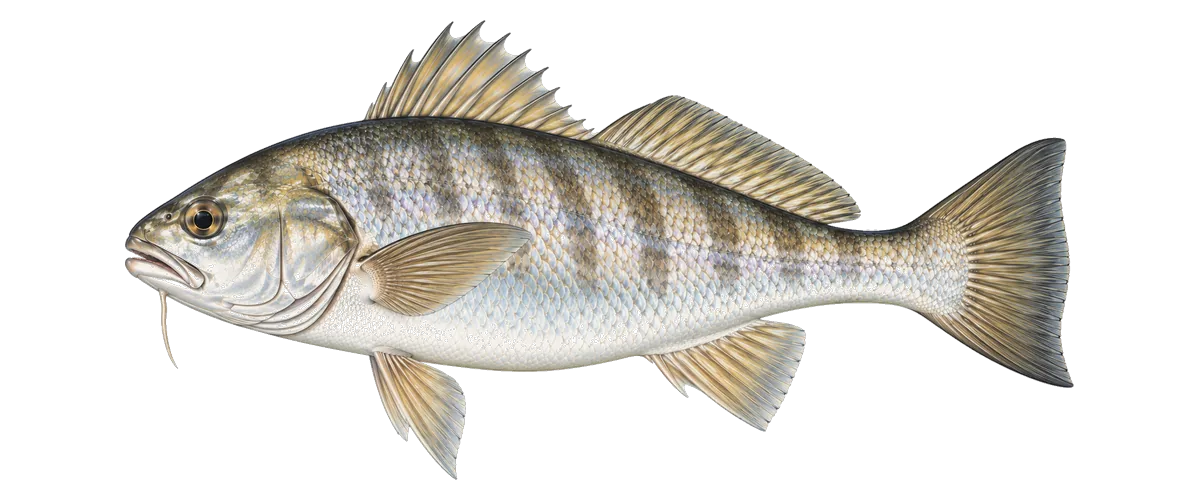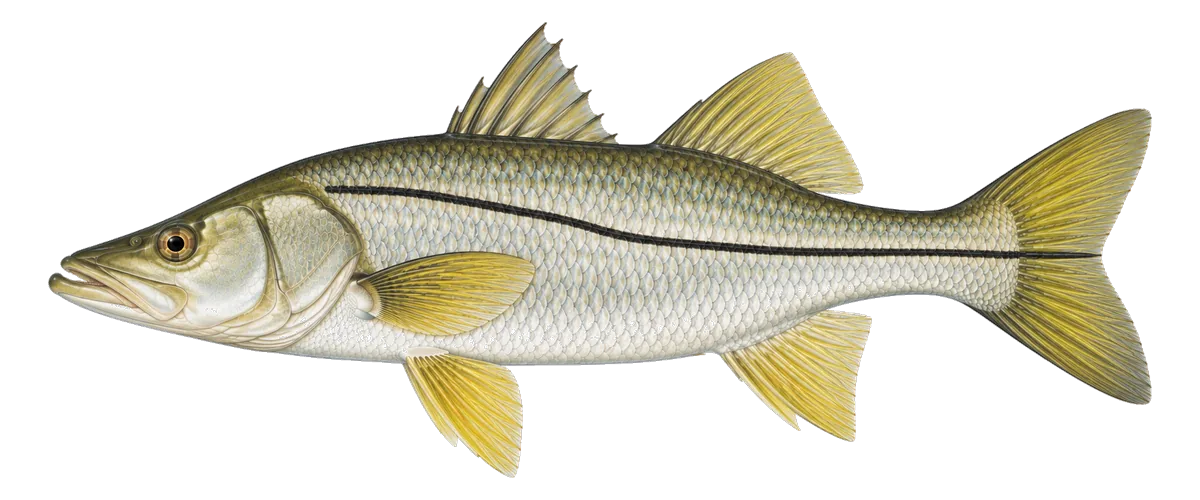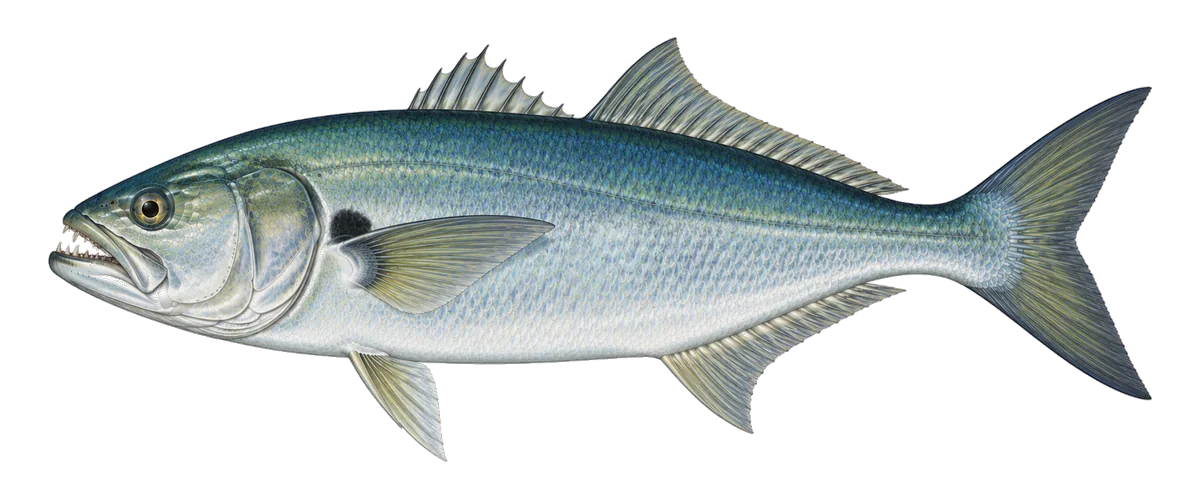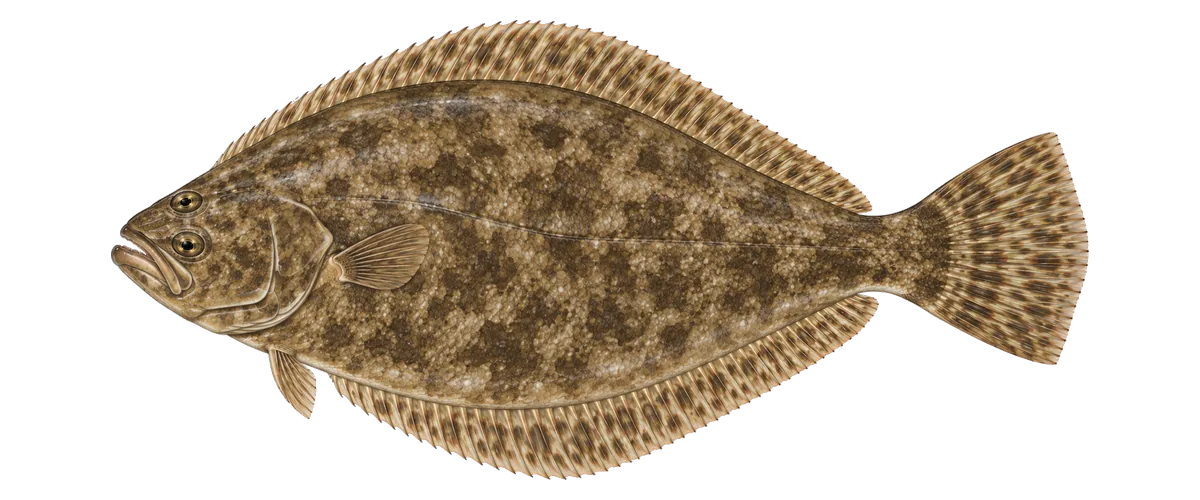
To catch flounder in Florida in the fall, fish where they funnel out of the bays on their way offshore to spawn: inlets, passes, channel edges and the mouths of marsh creeks on a falling tide. Drag a live mud minnow or finger mullet slowly along the bottom on a Carolina rig, or hop a bucktail or a Gulp on a jighead, and when you feel the thump, give the fish time to eat before you set the hook. Check the season before you plan on dinner: Florida closes flounder harvest for part of the run.
Below: telling the three flounders apart, when and where the run happens, baits, rigs, lures and the hook set, piers and the surf, and the rules by state.
Which flounder you're catching: southern, gulf or summer
Three flounders turn up on hook and line in the Southeast, all left-eyed flatfish with both eyes on the side that faces up. The quickest way to tell them apart is the eyespots: dark spots ringed with a paler color, which biologists call ocellated. North Carolina's Division of Marine Fisheries uses these marks:
- Southern flounder: no eyespots. Its spots and blotches are dark but never ringed.
- Gulf flounder: three prominent eyespots that form a triangle, with the point toward the tail.
- Summer flounder: at least five eyespots, the five biggest laid out like the five on a die.
The spots can fade on big fish, so look closely.
Southern flounder is the big one, and the one most Florida anglers catch in the backwaters. It lives in bays, estuaries and river mouths, prefers mud to sand, and runs well up into fresh water. South Carolina DNR's flounder booklet notes it's absent from the Keys and shows up again on the Gulf coast around St. Petersburg.
Gulf flounder is the smaller fish, reaching about 18 inches, and it leans toward sand and shell. You'll find it in the bays too, but more often in passes, around nearshore reefs and on the ocean side. In the Keys, where southern flounder are missing, a flounder is most likely a gulf.
Summer flounder, the fluke, is the Atlantic coast's flounder. NOAA Fisheries says it ranges from Nova Scotia to Florida's east coast but is most abundant from Cape Cod to Cape Fear. In Florida it's an occasional Atlantic-side catch; in the Carolinas it's common around inlets, piers and the beaches. It chases bait up off the bottom more than the other two.
The three are managed under separate plans, and while most Southeast states treat them alike, some set different rules for each. When you aren't sure which one is on the deck, Taklbox can name it from a photo.
When is the flounder run?
Flounder spend the warm months in the bays and creeks and spawn offshore in late fall and winter. The fall run is the trip out: the fish gather in the lower bays, then pour through the inlets and passes to the ocean. Because they all leave by the same few doors, they're never easier to find.
Water temperature sets the timing:
- Southern flounder in Louisiana start a mass migration to the Gulf between mid-October and mid-November, according to LSU's Sea Grant fisheries program. They spawn offshore from November through January, with a peak in December. A slow cool-down stretches the run out; a strong cold front can send them out all at once.
- In Texas, Texas Parks and Wildlife puts the fall run from October to December, in the channels and passes leading to the Gulf. Males usually leave first, once the water drops by 7 to 9°F.
- Gulf flounder spawn offshore from October through February, as the water cools from about 73°F to 57°F, per North Carolina's marine fisheries division.
- Summer flounder leave the sounds and beaches for the continental shelf in the fall, and NOAA puts their spawning peak in October and November.
The run doesn't keep a calendar. Texas researchers counting flounder at Aransas Pass and Packery Channel found the run peaked in late October and November in 2022, a year of early cold fronts, and ran into December in 2023. Warmer water seems to be pushing it later, and Texas extended its fall closure deeper into the year to follow it.
The fall run and Florida's closed season
FWC closes flounder harvest during the weeks when the fish gather before spawning, so more of them get to spawn. It added the closure after a stock update found Florida's flounder declining statewide. In practice, the heart of the run is catch-and-release in Florida.
That still leaves plenty of fishing. Fish the front of the run before the closure, release everything during it, and fish again when harvest reopens. Flounder that winter inshore hold in deep holes and channels, Texas Parks and Wildlife notes. The dates are on the Florida card below.
During the closure, a flounder you release can still go in your log: on iPhone Pro models, Taklbox measures it from the photo before it swims away.
Where to find flounder during the fall run
Flounder are ambush feeders. They lie half-buried, color matched to the bottom, and wait for the current to bring food past. Look for moving water that carries bait over a spot a flounder can hide.
- Inlets and passes. The chokepoint on the way out. Fish the channel edges, the eddies behind jetty rocks and points, and the sand slopes where the current eases.
- Creek mouths and marsh drains on the falling tide. South Carolina DNR's surveys found southern flounder were the last big fish to leave the shallows on the ebb. They wait at the mouths of the gullies that drain the marsh, where the falling water flushes out mullet and mud minnows.
- Eddies. SCDNR's anglers look for spots where the current turns back on itself behind a point, a sandbar or the junction of two creeks, and fish the lee side of oyster rocks and marsh islands.
- Docks, pilings and jetties. Florida Sportsman's Capt. Roger Bump starts deep at low tide, around jetties and deep docks, and works up to grass lines, oyster bars and sandbars as the tide comes in. He says a single piling can hold several fish.
Whatever the spot, you need moving water. Melvin Burns, one of the veteran anglers in SCDNR's booklet, finds the best fishing in the two hours either side of the tide change, the falling tide usually best. At mid-tide the current runs too fast to drift a bait well.
The channel edges, drop-offs and deep holes flounder use on the way out show up on a depth chart before you leave the dock.
The same inlets fill with redfish in the fall, too. See where redfish go in the fall.
Best bait for flounder
Live bait is the most popular way to catch flounder, and two baits stand out: mud minnows and finger mullet. Both are what flounder eat: in more than 300 southern flounder stomachs, SCDNR biologists found mud minnows (mummichogs) and small mullet among the main prey.
- Mud minnows. The easiest to get and the toughest on the hook. Most saltwater bait shops sell them, or trap your own with a crushed blue crab for bait. They live in a bucket on little more than clean salt water.
- Finger mullet. Throw a cast net along the beaches and creek mouths, especially when the fall mullet run is on. Florida Sportsman ranks finger mullet and mud minnows as the two most effective flounder baits.
- Live shrimp. Excellent when the creeks are full of shrimp, but everything else eats them too, so bring plenty.
- Small menhaden, spot and croaker. Burns calls these silvery baitfish "white bait" and, from the stomachs of hundreds of flounder, rates them the best bait of all.
Don't go too small. SCDNR's Jay Sims uses minnows of two inches or more, because a flounder won't give away its hiding place for a tiny one. His father's rule: "The smallest flounder can eat the biggest minnow."
How to hook them:
- Mud minnows: SCDNR's Walt Cordina hooks them through the lips, bottom to top.
- Finger mullet: Cordina hooks them crosswise through the eye sockets.
- Through the head: Bump runs the hook in through the mouth and out the top of the head, so the bait breathes more easily than when it's hooked through both lips.
However you hook it, keep the bait lively. Bump carries plenty to swap out a tired one, because a dead bait can sit untouched in a good spot.
How to rig for flounder: the Carolina rig
The flounder rig almost everyone starts with is the Carolina rig: a sliding egg sinker on the main line, a swivel, a short leader and a single hook. The sinker drags the bottom and the bait swims just above it, where a flounder looking up will see it.
Walt Cordina's version, from SCDNR's booklet:
- a 1/8- to 1/4-ounce egg sinker on the main line
- a small black barrel swivel
- 10 to 12 inches of 17- to 20-pound leader
- a 2/0 hook
Bump's is much the same: a sliding sinker over a bead, about a foot of 20-pound leader and a Kahle hook. Use the least weight that holds the bottom: more in a hard-running inlet, less in a quiet creek. Around rocks and pilings, where a dragged rig hangs up, fish it straight up and down.
Fish it slowly. Drift with the tide or crawl the rig along the bottom, and pay attention to what you feel. Sims imagines riding along on the sinker: after a while you can tell shell from sand ripples from mud. If the bait suddenly turns frantic, it's dodging something, a fish or a crab. Get ready.
One hook is all you need, and in Florida it's the safe choice: FWC's flounder rules prohibit harvest with any multiple hook used with live or dead natural bait. For a bait held just off the bottom, Cordina sometimes uses a popping float instead. When the float goes under slowly, he says, it's usually a flounder.
How to set the hook on a flounder
Burns calls detecting the strike one of the hardest things for beginners to learn. It's almost always a distinct thump, followed by a heavy feeling, as if you'd picked up a crab or some trash. That's the flounder grabbing the bait. Flounder often hold a bait for a while before they swallow it, Florida Sportsman notes, and if you set now, you pull it out of the fish's mouth.
So wait:
- Give it line. At the thump, open the bail and let the line go. Burns gives it 5 to 10 seconds.
- Count. Sims says some anglers count to ten, some longer, depending on the day's bite. Miss one, and count longer next time. Bump often waits more than a minute, keeping the line just tight enough to feel the fish chewing.
- Come tight, then set. Reel down until the line is tight. Burns and Cordina set hard, to drive the hook into the bony jaw; Bump prefers a steady lift of the rod over a hard swing.
If a bite takes off running instead, set right away: Sims says it's probably a trout, a redfish or a bluefish. And if you miss a flounder, mark the spot. Bump says they often strike again, sometimes within about 10 minutes.
Some flounder fight hardest when they see the boat, Sims finds, so keep the drag loose enough that the fish can't tear the hook free at the last moment. Bring a long-handled net, and never try to lift a good flounder over the side by the line.
How to catch flounder with artificial bait
A lure covers more water than a bait, which helps when the fish are spread along a channel edge. Work everything slowly, on or just off the bottom.
Bucktail jigs. The classic flounder and fluke lure. Nick Honachefsky of The Fisherman pops the rod tip to hop the bucktail across the sand, reels up slack with a slow, steady retrieve, and pauses about two seconds between pops. He lets it sit and wobble on the bottom now and then, because a following fish often comes back for it. Tip it with a soft plastic trailer or a strip of squid, and use the lightest jig that touches bottom in the current. His colors are white, yellow, pink and chartreuse.
Gulp and soft plastics on a jighead. Taklbox's own profiles for southern and gulf flounder list a soft plastic on a jighead among the top three baits, hopped slowly along the bottom over sand and near drop-offs. Bump likes a white Gulp worked close to the bottom. Cordina casts grubs around oyster bars in the fall, jigs them beside pilings, and sometimes tips them with a mud minnow for the reach of a lure and the smell of a bait.
Paddletail swimbaits. A paddletail on a jighead swims on its own with a slow, steady retrieve. Drag it down channel edges and across the mouths of drains, and let it bump the bottom.
Spinnerbaits. Bump's top flounder lure is a surprise: a spinnerbait, slow-rolled near the bottom for its flash and vibration. He uses an inline spinner in shallow water, where it snags less, and a gold blade in darker water, silver in clear.
How to catch flounder from a pier
A pier puts you over pilings and deeper water without a boat.
- Fish close to the pilings. Bump's single piling can hold several fish, and Cordina jigs grubs right beside them.
- Drop straight down. A rig fished straight below you hangs up less around pilings and rubble than one dragged across them.
- Work the bottom slowly. A mud minnow or finger mullet on a Carolina rig, crawled under and beside the pier, or a bucktail bounced the same way.
- Fish the moving tide. Bump's rule holds on a pier too: no matter what, make sure you have moving water.
- Bring a pier net. A good flounder lifted to the deck by the line is usually a lost one.
In the Carolinas, summer flounder are a pier fish too, caught on bucktails, jigs and bottom rigs.
How to catch flounder in the surf
In the fall, flounder bound for the ocean gather near the inlets, and the beaches beside them are worth a try. Fish the trough between the beach and the first sandbar, and the cuts where water drains out through the bar.
The Fisherman's surf playbook is written for mid-Atlantic fluke, but the basics carry over:
- Look for cuts and sloughs. At low tide, you can also cast past the outer bar to water you can't reach later.
- Fish the inside of the bar on the start of the incoming tide, when flounder feed in the slough.
- Catch one, stay put. Flounder travel in groups, and more may be within a few yards.
- Use a light bucktail or jighead, 3/8 to 1/2 ounce, with a soft plastic minnow trailer, popped and paused across the bottom. Keep retrieving after a missed strike; a fish may follow it a long way before it hits.
For bait, fish a mud minnow or finger mullet on a fish-finder rig in the trough. The same fall mullet run draws redfish into the surf; the best bait for redfish covers that side of the beach.
Flounder rules: fall closures by state
Southern flounder have declined in several states, and many now close harvest during the fall run so the spawners get out. Each card below comes straight from the data Taklbox checks your catch against, with the agency's official link.
FWC's flounder rule covers southern, gulf, summer and fringed flounder alike, and it applies in federal waters off Florida too. Harvest closes for part of the fall run.
Alabama, Louisiana and Texas also close flounder harvest during the run.
Georgia and South Carolina have no closed season on file, but each sets its own size and bag, and South Carolina adds a per-boat cap. Both apply the same rule to all three flounders.
North Carolina sets its flounder season each year by proclamation. In 2026 its coastal, joint and inland waters shared one short season that closed before the fall run, and every flounder kept had to be reported. The card below is the inland-waters rule on file; the coastal season ran on the same dates.
Not sure whether the flounder in your hands is legal where you caught it? Snap it: Taklbox names it, measures it on iPhone Pro models, and checks the size, bag and season where you caught it.
Frequently asked questions
When is the flounder run in Florida?
In most years it builds through October and November as the water cools, and the first strong cold fronts set it off. FWC times its harvest closure to the weeks when flounder gather to spawn, so much of the run is catch-and-release.
Is flounder in season in Florida?
For most of the year, yes, but harvest closes for part of the fall run. The Florida card above has the dates and FWC's link, and Taklbox checks the season for you where you catch the fish.
What size hook for flounder?
Cordina ties a 2/0 on his Carolina rig, SCDNR's Dickie Hamilton uses 2/0 or 3/0 wide-gap hooks (bigger for bigger baits), and Bump pairs a 2/0 Kahle with his jig rig.
Do flounder feed at night?
Yes. At night flounder lie in water shallow enough to see from a boat. That's why gigging, spearing them under lights mounted on the bow of a boat poled along the shallows, is a night fishery, and a big one in the Carolinas. FWC lists gigs among the legal gear for flounder in Florida. For more techniques, see the rest of the Taklbox how-to guides.