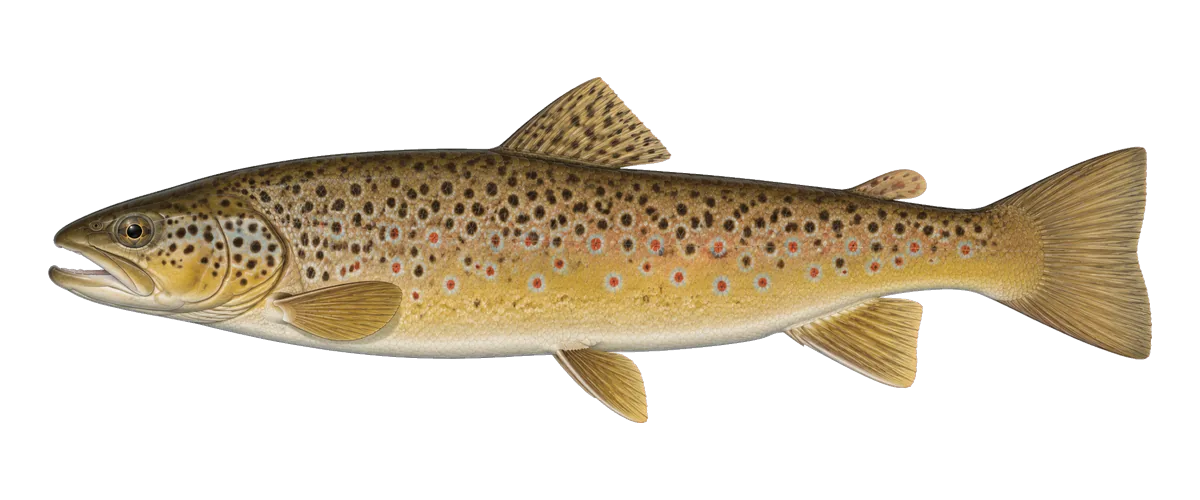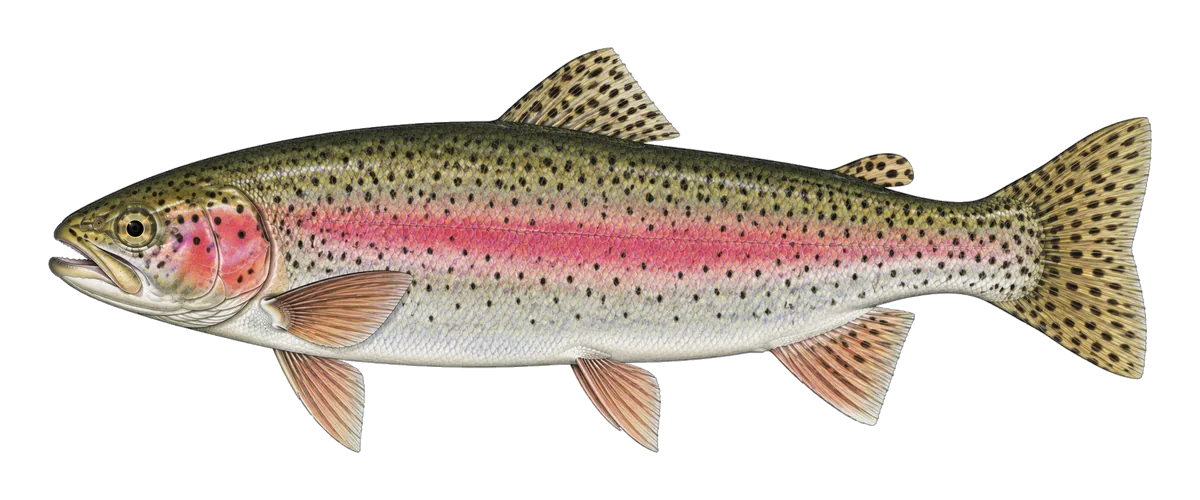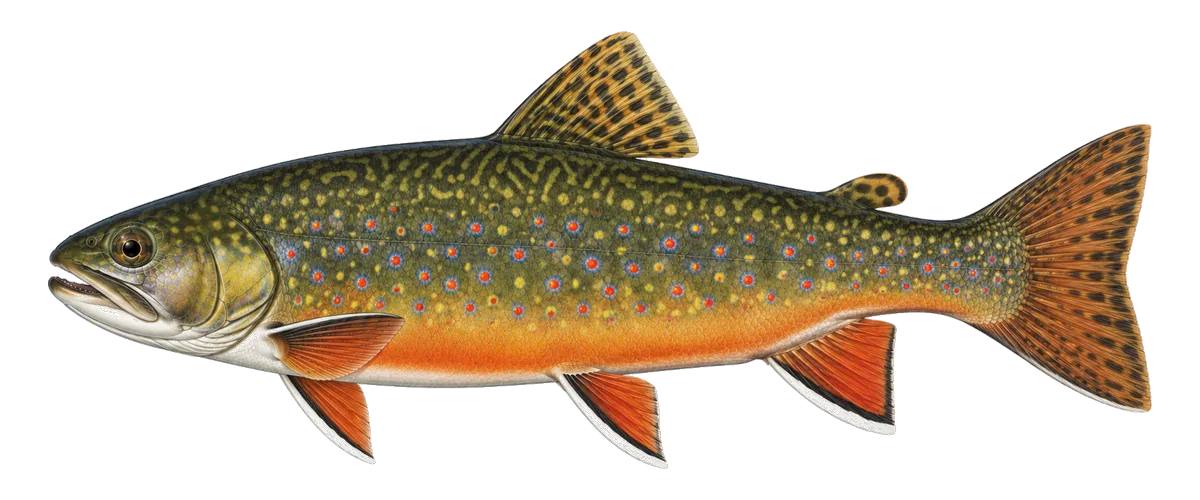
A brook trout has pale spots on a dark olive body, wormlike markings on its back, and lower fins edged in white and black. Brown trout and rainbow trout are the reverse, dark spots on a lighter body, and the tail tells those two apart: a rainbow's tail is spotted all over, a brown's has few spots or none. Rainbows also carry a pink band down the side, and browns often have red spots.
Below: the three side by side, how to identify each one, brook vs brown and rainbow vs brown up close, young trout, tiger trout and other hybrids, where each one lives, which grows biggest, and why the difference matters for what you can keep.
Brook trout vs brown trout vs rainbow trout at a glance
From the Virginia Department of Wildlife Resources (DWR) species profiles, the U.S. Geological Survey (USGS) and the Great Lakes Sea Grant identification guide:
| Brook trout | Brown trout | Rainbow trout | |
|---|---|---|---|
| Body and spots | Pale spots on dark olive | Dark spots on brown or yellow | Dark spots on silver or olive |
| Red spots | Many, often in blue halos | Often, in pale halos | None |
| Back | Wormlike markings | No wormlike markings | No wormlike markings |
| Tail | Not spotted across | Few spots or none | Spotted all over, in rows |
| Lower fins | Red-orange, white and black front edge | No white and black edge | Often a white tip, no black edge |
| Side | Orange belly | Golden-brown | Pink band |
| Spawns | Fall | Fall | Spring |
| Native to | Eastern North America | Europe, North Africa, western Asia | Pacific drainages of North America |
How to identify a brook trout
Virginia DWR lists four marks:
- Pale spots on a dark olive body, the reverse of browns and rainbows.
- Wormlike markings across the back, called vermiculations.
- Red-orange lower fins with white leading edges, backed by a black stripe.
- Red spots, many of them ringed in blue.
The brook trout isn't a true trout. It's a char, in the genus Salvelinus with lake trout, and like them it wears light markings on a dark body. In fall, when brook trout spawn, their colors get brighter and males grow a hooked lower jaw called a kype.
It's Virginia's state freshwater fish, and the only trout native to the Great Smoky Mountains.
How to identify a brown trout
- Dark spots on a light body, in browns and yellows.
- Black spots ringed in pale halos on the upper body, and red spots lower down, sometimes on the gill plate or fins too.
- Few spots on the tail, or none.
- A red edge on the adipose fin, the small fleshy fin on the back behind the dorsal fin, which USGS lists among the brown trout's marks.
Browns spawn in the fall too, when Virginia DWR says the adipose fin and tail can turn a vivid red.
What's a German brown trout? The same fish. USGS records that brown trout first came to the United States in 1883, from Germany, and were stocked in Michigan's Pere Marquette River. Browns have since been stocked in nearly every state.
How to identify a rainbow trout
- Dark spots on a light body, silver to olive, with the back darker.
- Black spots across the tail and dorsal fin, even and prominent, and on the tail they line up in rows.
- A pink band along the side, and a rosy gill plate.
Rainbows from lakes can run silvery with a steel-blue back. When they spawn, in spring, the pink band turns crimson and the spots get bolder. A steelhead is a rainbow trout that went to sea and came back to spawn.
Brook trout vs brown trout: three checks
Brook and brown trout both spawn in the fall, both color up for it, and both can have red spots. Check three things:
- The spots. A brook trout's are pale on a dark body, a brown's are dark on a light body.
- The lower fins. Only a brook trout has the white leading edge with black behind it on the pectoral, pelvic and anal fins.
- The back. Wormlike markings mean a brook trout. A brown trout's back is spotted, not marbled.
Red spots alone don't settle it. A brook trout's are ringed in blue, a brown's in a pale halo.
Snap the fish and Taklbox names it on the phone itself, with no signal, which helps on a mountain stream.
Rainbow trout vs brown trout
- The tail. A rainbow's is spotted edge to edge. A brown's has few spots, faint ones, or none.
- The color. Rainbows are silvery with a pink band, browns golden-brown or yellow.
- Red spots point to a brown. Rainbows don't have them.
Virginia DWR also calls a brown's tail square and a rainbow's forked, but the Great Lakes guide draws a rainbow's tail nearly square, so trust the spots over the shape.
Don't let a white fin tip fool you into calling a rainbow a brook trout. Rainbows often have white tips on their lower fins, but Virginia DWR notes they lack the black edge behind it.
Telling young trout apart
Young trout wear parr marks, dark oval bars along the sides. USGS counts eight to thirteen on a young rainbow. The Great Lakes Sea Grant identification guide points to the adipose fin: orange on a young brown trout, rimmed in black on a young rainbow. Otherwise, start with the adult tells: the brook trout's white and black fin edge, and the rainbow's spotted tail.
Tiger trout and other hybrids
Tiger trout are a cross of a brown trout and a brook trout. Connecticut's Department of Energy and Environmental Protection describes them as in between their parents, with a maze of light and dark markings over the back and sides, a little like a brook trout's wormlike back.
- They're sterile, so they can't breed with either parent or with each other.
- Most are stocked. Hatcheries make them by crossing male brook trout with female brown trout. Wild ones can turn up wherever both parents live, but Connecticut says they're never common, and almost all the tiger trout its anglers see are stocked.
Splake are another brook trout cross, with lake trout, and they can look like either parent.
Where brook, brown and rainbow trout live
- Brook trout are native to eastern North America, from Newfoundland and Hudson Bay down through the Great Lakes, and along the Appalachians as far south as north Georgia. They need cold, clean, oxygen-rich water.
- Brown trout are native to Europe, North Africa and western Asia. Virginia DWR says they tolerate warmer water and pollution better than other trout and tend to take over the best water. USGS cites studies where adult browns pushed native brook trout out of their best habitat.
- Rainbow trout are native to rivers draining to the Pacific, from Alaska to Mexico. States have stocked them since the late 1800s, and most states still stock them.
In the Great Smoky Mountains, all three are wild, and the National Park Service says brook trout are most at home in the high, steep, shaded headwaters. See Smoky Mountains trout fishing. For the stocked streams with fall-to-spring catch-and-release seasons, see delayed harvest trout.
Which trout gets the biggest?
The brook trout is the smallest of the three. Browns and rainbows both grow big, and in Virginia browns pass 20 inches more often.
- Brook trout in Virginia typically run 6 to 12 inches and live three or four years.
- Brown trout in Virginia commonly pass 20 inches and can live ten years or more. Big ones turn to eating fish and feed hardest at night.
- Rainbow trout in Virginia can pass 20 inches too, and live about as long as browns.
USGS lists the largest brook trout at about 28 inches, browns at about 41 and rainbows at about 45.
On iPhone Pro models, Taklbox measures the trout from the photo you take of it, so a wild fish is out of the water only as long as the picture takes.
Why it matters which trout you caught
Many states, like Tennessee and Georgia, set one trout rule that covers all three species. Others set a different rule for each, and Kentucky's are a good example. Brook trout are catch-and-release only, with a few exceptions:
Brown trout have their own minimum size and a smaller daily limit:
Rainbows have a separate limit:
So in Kentucky, mistaking a brook trout for a brown, or a small brown for a rainbow, can mean keeping a fish you had to release. For more on trout, see the species guides.
Snap the fish and Taklbox names the species first, then checks that species' size, bag and season rules where you caught it, with a link to the official rules.
Frequently asked questions
Is a brook trout a trout?
Not technically. It's a char, in the genus Salvelinus with lake trout, while brown trout are Salmo and rainbow trout Oncorhynchus. Anglers and fishing rules still call it a trout.
What is a German brown trout?
It's the brown trout. The first ones brought to the United States came from Germany in 1883, and the name stuck.
Which trout has spots on its tail?
The rainbow. Its tail is spotted all over, in rows. A brown trout's tail has few spots or none, and a brook trout's isn't spotted across.
Can brook trout and brown trout breed?
Rarely, in the wild. Their offspring are tiger trout, which are sterile, and most tiger trout are hatchery fish.
Which is bigger, a brook trout or a brown trout?
Usually the brown. In Virginia, brook trout typically run 6 to 12 inches, while browns commonly pass 20.