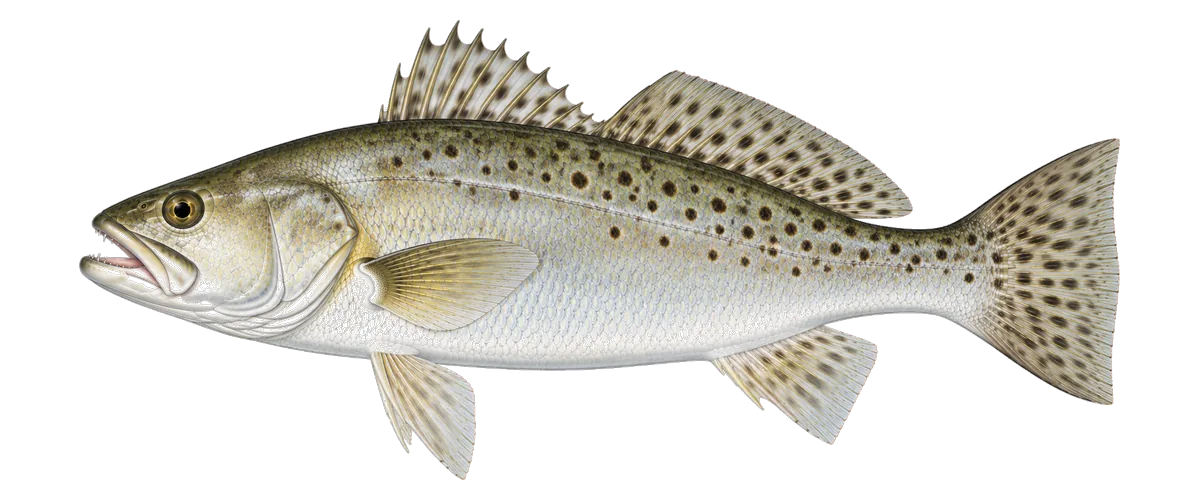
To catch speckled trout, fish moving water where grass, shell and sand meet a little deeper water, at dawn and dusk. Hang a live shrimp under a popping cork, or work a soft plastic on a light jighead, on a light spinning rod with braid and a fluorocarbon leader. Trout have soft mouths, so reel steadily rather than horsing them. The same basics work wading a shoreline, standing in the surf, walking a pier or drifting a flat in a boat.
Below: where trout hold and when they feed, the tackle to use, then how to fish for them from shore, in the surf, from a pier and from a boat, and how to land and handle them.
Where to find speckled trout
Speckled trout live in shallow bays and estuaries from Texas to the Chesapeake, and they go where the food is. Texas Parks and Wildlife describes them cruising the seagrass beds of shallow bays in spring and summer, and gathering around oyster reefs, channels and the drop-offs at the edges of grass flats.
The spots that hold trout usually have three things:
- A mix of bottoms. Where sand, grass and shell meet. Sandy potholes in a grass flat are classic: trout sit in the grass and ambush whatever crosses the sand.
- A little more depth nearby. A drop-off, a channel edge, a gut or a deeper hole the fish can slide into when the sun gets high or the water cools.
- Moving water and bait. A current pushing shrimp and small fish past them. Look for nervous bait, birds diving, and the slicks feeding trout leave on the surface.
The season moves them around. Trout spread over the shallows in spring and summer, and in fall they shift toward deeper bay water, creek and river mouths and bayous. For the fall move, see where speckled trout go in the fall.
Reading the bottom before you go saves hours. Taklbox Pro shades charted depth on the map, so the drop-offs, channels and deeper holes near a flat stand out.
When to fish for speckled trout
Dawn and dusk. In warm weather, Texas Parks and Wildlife's advice is to fish the shallows early in the morning and late in the evening, then move to deeper water, like the drop-offs around grass flats, channels or oyster reefs, in the heat of the day.
A moving tide. Trout feed when water moves bait past them. In the Louisiana surf, Sammy Romano finds big trout feed best in the last hour of the incoming tide and the first hour of the falling tide. On the flats, the falling tide pulls shrimp off the grass and out of the marsh drains.
After a cold front. In very cold weather, Texas Parks and Wildlife points anglers to deep rivers, harbors and channels, and finds them best as the skies clear and it warms up after the front passes.
Not right on the full moon. Romano finds the day of a full or new moon usually isn't the most productive, and prefers the four or five days on either side.
Every trout you catch tells you something about the tide and time it bit. Taklbox saves each catch with its place, bait, tide, moon and barometer reading, so you can line up your best days.
Speckled trout tackle setup
Trout don't need heavy tackle. Texas Parks and Wildlife says any light to medium rod and reel made for saltwater will do. A typical setup:
- Rod: a 6- to 7-foot light or medium-light spinning rod with a soft tip, which keeps from tearing the trout's mouth. Baitcasters work too, and many Texas waders use them.
- Line: 10- to 20-pound braid for long casts and feel.
- Leader: 2 to 6 feet of 15- to 25-pound fluorocarbon.
- Terminal tackle: a 1/8- or 1/4-ounce jighead for soft plastics, or a small hook for live bait.
Two real setups for comparison. Salt Water Sportsman's veteran Texas wader fishes a 6-foot rod with a baitcaster, 20- or 30-pound braid and a 25-pound fluorocarbon leader. For croakers in the Texas surf, James Kosub uses a 7-foot rod, a 3500-size spinning reel, 20-pound braid and about 6 feet of fluorocarbon.
How to catch speckled trout from shore
Wading a shoreline is the classic way to catch speckled trout, especially in Texas, and it puts you closer to the fish than any boat can.
Pick the water by the tide. Salt Water Sportsman's Texas wader finds that on high tides trout spread across knee- to waist-deep flats, often tight to the shoreline. On low tides they drop off the shorelines into deeper guts, and he wades out to chest-deep water to cast to the drop-offs. On an incoming tide he works sand and grass flats, casting to the sandy pockets.
On a reef, he fan-casts the top, the drop-off and the deep water around the shell bar, and lets the bait decide where the fish are.
Move slowly and quietly. Shuffle your feet as you wade so you nudge stingrays out of the way instead of stepping on one. Cast before you wade in, and cover the water close to shore first.
Lures for wading: a topwater early, a soft plastic on a jighead once the sun is up, and a suspending twitchbait for the middle of the water column.
If you don't have a boat, Taklbox Pro maps boat ramps and fishing piers, and shades public land, so you can find shoreline you're allowed to fish.
How to catch speckled trout from a pier
Piers put you over deeper water without a boat, and trout come to them to feed on the bait the pilings and the surf hold.
Find the school. On North Carolina's Oak Island piers, Luke Horn and Roger Gates start at different ends and work along the pier until one finds the fish. Trout move with the bait: Horn says that one day they're right behind the breakers and the next they're out near the end.
Rigs that work from a pier:
- A sliding float. Horn fishes a slip cork with 18 to 24 inches of 20-pound fluorocarbon and a small treble hook, with a live shrimp hooked under the horn or a mullet minnow through the lips. A heavier cork and sinker handle a windy day.
- Bait off the bottom. When the wind makes a float hard to fish, Allen Lakey switches to a sidewinder rig, similar to a drop-shot, which holds the bait a few feet off the bottom.
- Live-lining. When Spanish mackerel and bluefish are around, Lakey adds a short 30-pound mono leader so they don't bite through.
- A soft plastic. For artificials, Horn uses a 3-inch pearl or white Gulp! Shrimp on a light jighead.
Fish early and late. Lakey finds the pier bite best from daylight to about 10 a.m. and again in the late afternoon. Bring a pier net or a drop net for the bigger fish, since a trout's mouth often tears on a long lift up to the rail.
How to catch speckled trout in the surf
On calm summer mornings, trout move into the surf along the Gulf and Atlantic beaches to feed on bait in the troughs between the sandbars. It's some of the best big-trout fishing there is, and it doesn't need a boat.
Wait for calm, "trout green" water. Romano looks for seas under 3 feet with a 6-second or longer interval, winds of 10 knots or less, and light southeast winds, and avoids west winds. His favorite water is slightly off-colored, the green the surf turns when it's clean but not clear. In very clear water, Spanish mackerel and bluefish show up and bite off lures. Kosub watches for the deep green water to push to the beach, and finds the trout come with it.
Fish the guts. The surf is a series of sandbars with deeper troughs, or guts, between them, and the guts get deeper the farther out you go. Kosub wades to the first or second bar and casts where it drops off into the gut. Breaking waves show where the bars are. Romano adds island tips, passes and cuts, and the slightly deeper holes big trout settle in.
Start on the sand. Romano casts from the beach first and works his way out slowly. Wading deeper than you need to spooks fish and makes fishing harder.
Be early. Kosub finds a summer surf bite rarely lasts past 9 a.m.
Baits for the surf:
- Live croakers. Kosub free-lines a croaker on a 2/0 Kahle hook with no weight, with the bail open so it swims freely. When a trout takes it, he counts to three once it's pulling line steadily, then closes the bail and sets the hook.
- Hard baits with a big profile. Romano throws topwaters and suspending twitchbaits like the MirrOdine.
- Soft plastics on a jighead, worked slowly along the bottom of the gut.
Mind the surf itself. Kosub warns that the waves are usually rougher than they look and rip currents can shift quickly. Shuffle your feet for stingrays here too, and keep your fish on a long stringer well away from you, or skip the stringer, where sharks are about.
How to catch speckled trout from a boat
A boat lets you cover water, and on the Gulf coast covering water is how trout are found.
Drift the grass flats. Florida Sportsman calls drifting shallow grass flats the king of Florida inshore fishing in all but two or three chilly months of the year, with trout the usual target. Set up upwind of the flat and let the breeze carry you across it, casting ahead of the drift.
- Control the angle. A boat with its outboard down drifts at an angle. Turning the motor hard to the upwind side straightens the drift, and tilting the motor all the way out of the water usually brings the boat broadside, so lines don't tangle.
- Mark the fish. Trout come in flurries. Mark each bite with a GPS waypoint or a marker buoy, then circle back upwind, wide of the fish, and drift through again.
Work a cork over the grass. A jig or live shrimp under a popping cork is the standard drift rig. Capt. William Toney sets an 18- to 24-inch leader under the cork on grass flats in 3 to 5 feet of water, so the bait rides just over the grass. For the rig and how to work it, see the popping cork rig.
Look for birds and slicks. Texas Parks and Wildlife notes that boat anglers look for groups of gulls feeding in summer and fall. Trout push shrimp to the surface and the birds give them away. A slick, an oily calm patch on the water, often means trout feeding below it; Romano finds the fish are usually up-current of the slick.
Anchor on the edges. When the sun is high or the water's cold, trout drop to the deeper edges. Anchor or stake out off a drop-off, a channel edge or an oyster bar, and cast into it instead of drifting over it.
The best bait for speckled trout
The short list, with more in the best bait for speckled trout:
- Live shrimp. Texas Parks and Wildlife calls it the best bait. Hook it under the horn so it stays lively, and use it under a cork, free-lined, or on a slip float.
- Live croakers, finger mullet and pinfish for bigger trout, which eat mostly fish.
- Soft plastics: a shrimp imitation or a paddletail on a light jighead.
- Topwater plugs early, on calm water, for the biggest trout of the day.
- Suspending twitchbaits for fish holding a little deeper or slowed by cool water.
Vary the retrieve. Some days trout want a lure darting erratically, and some days a slow, steady crawl, so change it up until they tell you. When they won't come up for a topwater, Salt Water Sportsman's wader switches to a soft plastic and bumps it along the bottom.
Hooking, fighting and landing speckled trout
A speckled trout's mouth is thin and soft, and more trout are lost to a hard hookset or a horsed fight than to anything else.
- Set the drag light. Let a big trout run.
- Reel to set the hook. On a circle hook, just reel when the fish takes. On artificials, a firm sweep of the rod is enough; don't snap it.
- Keep steady pressure and let the soft rod tip absorb the head shakes. Slack line lets the hook fall out.
- Use a net for a big trout rather than lifting it by the line, and a pier net from a pier.
For a trout you're releasing, wet your hands, keep it in the water as much as you can, and send it back gently. Horn releases the trout he catches on lures, since a single hook comes out easily.
Speckled trout rules: size and bag limits
Every state with speckled trout manages them with size and bag limits, and many use a slot. Florida sets its rules by region, and some regions close for part of the year. The cards below show the rules in the states where people fish for them most, from the data Taklbox checks your catch against, each with the official link. For every state, see speckled trout size limits by state.
A trout's length decides whether it goes in the cooler, so measure it right: mouth closed, tail pinched, straight line. See how to measure a fish. Snap the trout and Taklbox names it, measures it on iPhone Pro models, and checks the size, bag and season where you caught it.
Frequently asked questions
What is the best time to catch speckled trout?
Early morning and late evening, on a moving tide. In summer, fish the shallows at first light and move to deeper drop-offs and channels as the sun gets high. In the surf, the summer bite is usually over by mid-morning.
Can you catch speckled trout from shore?
Yes. Wade a grass flat or a shell shoreline, fish the surf on a calm morning, or work a pier, bridge or dock. On high tides, trout often feed right along the shoreline.
How do you catch speckled trout at night?
Fish lighted docks, bridges and piers near deep water. The lights draw shrimp and small fish, and trout feed at the edge of the light. Free-line a live shrimp up-current and let it drift through. The best bait for speckled trout covers dock-light fishing in detail.
What is the best rig for speckled trout?
A live shrimp or soft plastic under a popping cork, with the leader set so the bait hangs just over the grass, is the most popular. In deep holes and strong current, free-line a shrimp on a light hook with little or no weight.
What size hook should I use for speckled trout?
Match it to the bait. A small hook, or a 1/8- to 1/4-ounce jighead, for shrimp and soft plastics; Kosub uses a 2/0 Kahle hook for live croakers in the surf.