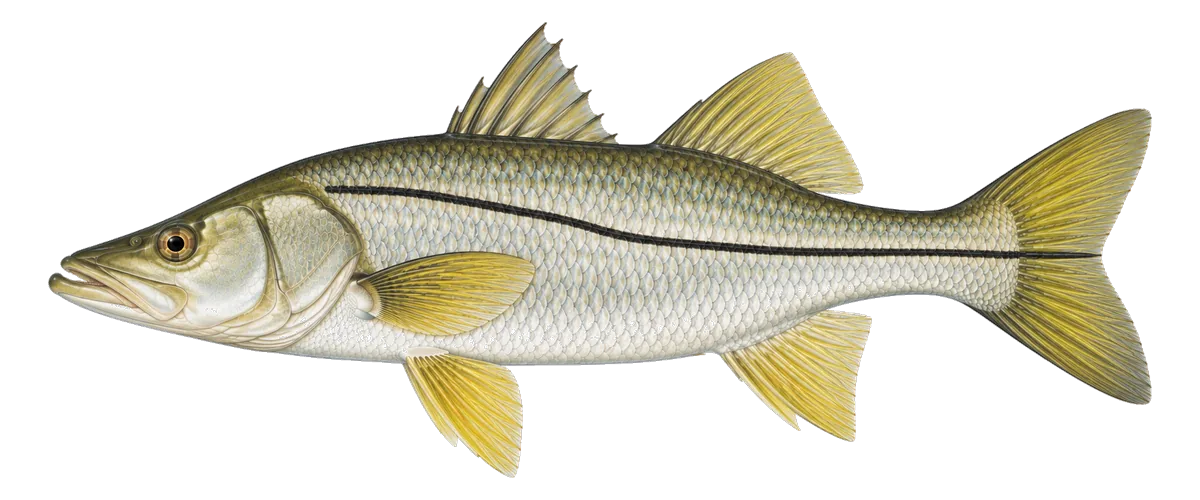
Snook season in Florida is open for harvest in spring and fall and closed through the winter and the summer, and the exact dates depend on where you fish. FWC manages snook in nine regions: the east coast's seasons run longer than the west coast's, and Charlotte Harbor and the Southwest, which takes in the Keys, open last in the fall. You can catch and release snook all year. The card below shows each region's open months, straight from FWC's current rules.
Below: how the season works on each coast and in the Keys, why the harvest closes in winter and summer, the slot and how to measure for it, the snook permit, and how to release snook well in the closed season.
Snook season in Florida by region
Since January 2024, FWC has managed snook in nine regions and reviews each one every year. Three are on the east coast: Northeast, Indian River Lagoon and Southeast. Six are on the west coast: Panhandle, Big Bend, Tampa Bay, Sarasota Bay, Charlotte Harbor and Southwest. Regions with the same rules share a row on the card above, so it has four: the east coast, the northern and central Gulf coast, Charlotte Harbor and the Southwest, and the Keys.
The season on the card is the harvest season, the months you may keep a snook that fits the slot. Outside it, every snook goes back. The basics are the same statewide: a slot, a small daily bag, a snook permit on top of a saltwater license, and hook and line as the only legal gear. What changes by coast is the slot's top end and the calendar.
Florida draws its redfish rules by region too. If you fish both, the redfish size limits by state guide covers them.
When is snook season on the east coast of Florida?
The east coast runs one set of rules from the Georgia line to the Miami-Dade/Monroe county line, across FWC's Northeast, Indian River Lagoon and Southeast regions. It has the longest seasons in the state. Harvest closes later for the winter and later for the summer than on the west coast, and it reopens sooner after the winter break.
A few east coast details catch people out:
- Lake Okeechobee and the Kissimmee River are in FWC's Indian River Lagoon region, so the east coast rules apply there.
- The slot tops out a little lower on the east coast than on the west coast. Check the east coast row before you keep a fish near the top.
- Biscayne National Park has its own extra fishing rules on top of the Southeast region's, linked from FWC's snook page.
The two coasts are managed apart for a reason. Atlantic and Gulf snook are separate populations that don't interbreed, UF/IFAS Extension notes. Atlantic snook are more migratory, traveling between estuaries, and generally grow larger and live longer. Gulf snook tend to spend their whole lives in one estuary. FWC assesses each coast's stock on its own, and the coasts have had different seasons for more than two decades.
When is snook season on the Gulf coast of Florida?
The west coast has two calendars:
- Panhandle, Big Bend, Tampa Bay and Sarasota Bay, from the Alabama line south to near Venice, share one.
- Charlotte Harbor and the Southwest, from near Venice south through Everglades National Park and the Keys, share the other. Their summer closure runs longer, so fall harvest opens later there than anywhere else in Florida. That longer closure came with the regional rules in 2024.
Both west coast calendars close earlier for the winter than the east coast does and stay closed later into the spring. Both also close earlier ahead of summer.
The Gulf side has a long history of caution. After the January 2010 cold kill, FWC closed snook harvest statewide by emergency order. The Atlantic reopened later that year, but harvest in the Gulf, Everglades National Park and Monroe County stayed closed until the fall of 2013.
Snook season in the Florida Keys
FWC's Southwest region runs south through Everglades National Park and the entire Keys to the Monroe/Miami-Dade county line. So every snook caught in the Keys, on the ocean side or the Florida Bay side, falls under the Southwest region's west coast rules, not the east coast's. That's the card's Keys row.
Cross into Miami-Dade, around Biscayne Bay, and you're in the Southeast region, with the east coast's calendar and slot. Region lines fall at county lines, causeways, and lines of latitude and longitude near Venice and Alligator Point, and it's easy to be on the wrong side of one.
Taklbox settles that for you: it checks the slot, bag and season for the exact place you caught the fish, with FWC's official link on every verdict.
Why snook season closes in winter and summer
FWC says its regular closures are there "to help conserve the species during vulnerable periods, such as during cold weather." The summer closure falls during the spawn. Both are times when snook crowd into predictable places and are easy to catch.
Winter: the cold
Snook are tropical fish. FWC's researchers say they turn lethargic in water below about 65°F, and their range ends where the water drops to about 50°F. When a cold front pushes chilly water into the bays, snook pack into whatever warm water they can find: rivers, springs, deep residential canals, marina basins and power plant outflows. Sluggish and bunched up, they're vulnerable to anglers, and a cold-stressed fish doesn't need the strain of a fight.
The worst recent cold kill came in January 2010. Water around Sanibel stayed in the 40s and 50s for more than two weeks, and the Sanibel-Captiva Conservation Foundation describes masses of dead snook floating in Pine Island Sound, with losses estimated in the millions statewide. A cold snap in early 2026 held the water between the high 40s and 60°F for about a week, but SCCF saw die-offs nowhere near 2010's.
If you find cold-stunned snook, leave them alone. Brett Fitzgerald of the Snook & Gamefish Foundation, writing in Florida Sportsman, points out that fish that look dead may not be, and handling them does them no favors. He cites retired FWC snook expert Ron Taylor: survivors of a cold snap can still die weeks later, because the cold damages their slime coat and immune system. Report a fish kill to FWC's Fish Kill Hotline (800-636-0511).
Summer: the spawn
Snook spawn from about April or May through September or October, according to FWC's researchers, at the mouths of coastal rivers, at major inlets and passes, and along the beaches. FWC names Jupiter and Lake Worth inlets on the Atlantic and John's Pass and Clearwater Pass on the Gulf among the known sites. FWC has described the Atlantic summer closure as falling "during peak snook spawning."
Snook also change sex as they grow. Every snook starts life as a male, and larger fish turn female, so most of the biggest snook on a spawning ground are egg-laying females. The slot sends both the small fish and those big ones back.
Why the dates can change
Under the regional system, FWC scores each region every year on seven measures of the fishery and publishes an annual review on its snook page. The rules can change in response, region by region. That's why every rules card links to FWC's official page: check it before you keep a fish.
Snook size limit in Florida
Florida manages snook with a slot: a fish must be at least the minimum and no longer than the maximum, measured as total length. The two coasts share the bottom of the slot and differ at the top, as the card shows.
Measure total length the way FWC means it. UF/IFAS Extension describes it as:
- Lay the fish on its side.
- Close its mouth.
- Measure from the most forward point of the head to the tip of the tail, with the tail lobes squeezed together.
On a fish near either end of the slot, the tail squeeze can decide it. If it's that close, let it go.
A few more FWC rules for a snook you keep:
- Keep it whole until you're back on land. No filleting on the water.
- Hook and line only. No other gear is legal for snook.
- No selling. Snook can't be bought or sold in Florida.
- On a charter, the captain and crew can't keep a bag limit of their own.
Taklbox can measure the fish for you. On iPhone Pro models it reads the length from the photo you take anyway.
Do you need a snook permit?
To keep a snook, yes. FWC requires a snook permit as well as a recreational saltwater license to harvest snook, unless you're exempt from the license requirement. That includes shore anglers: FWC's license page says the permit is required "including shoreline fishing."
If you release everything, the safe answer is still yes. Florida law requires the permit "to take or possess any snook," and FWC's license page says it's needed "when taking or attempting to take snook," which covers fishing for them, not only keeping one. If you're targeting snook, carry the permit.
- Cost: FWC's license page lists an annual permit at $10, and a five-year permit for Florida residents.
- Included: the Gold Sportsman's License and the lifetime licenses include snook permit privileges.
- No refunds: FWC notes that permit sales are final, even if harvest closes after you buy.
Can you catch snook out of season?
Yes. FWC's own words: "Anglers may continue to catch and release snook during the closed season." A closed season means no harvest, so every snook goes back right away.
Snook survive release well when they're handled right. FWC's researchers say only about two percent of released snook die from being caught, and that "releasing your snook with a minimum of handling practically ensures that the fish will be taken again."
How to release a snook, from FWC's handling guide and its biologists:
- Use circle hooks with bait. FWC says they're 90% more likely to hook a fish in the mouth than in the throat or gut.
- Fish tackle heavy enough to land a snook quickly. A long fight on light line leaves it less able to swim after release.
- Unhook it in the water if you can, with pliers or a dehooker, and wet your hands before you touch it. If you net it, use a knotless, rubber-coated net, as FWC recommends.
- Don't hang a heavy snook by its lower jaw. FWC biologist Lisa Ockelmann-LoBello warns, in Salt Water Sportsman, that holding a heavy fish by the jaw for more than a few seconds can damage its jaw tendons badly enough to cripple its ability to feed. Hold it nearly horizontal, one hand on the lower lip and the other under the belly.
- Keep it out of the water no longer than you could hold your breath.
- Revive it facing into the current until it swims off on its own. Never pump it back and forth.
In the summer closure, the snook you catch at inlets, passes and beaches are often spawning fish. Land them fast and keep the photos quick. In the winter closure, snook in cold water are already stressed: keep the fight short, and leave stunned fish alone.
A released snook is still worth logging. Taklbox saves every catch with its photo, place, bait, tide, moon and barometer reading, private unless you choose to share it.
For what to throw in the closed season and the open one, see the best bait for snook.
Snook season in Texas
Texas has a small snook fishery at the southern tip of its coast. Texas Parks and Wildlife Magazine reports that most are caught along the South Padre Island jetties, in nearby South Bay and in the Brownsville Ship Channel, that early fall is the best time at the jetty, and that snook are rare enough north of Port Mansfield to make the newspaper. Texas sets its own slot and doesn't split the year into seasons the way Florida does.
Frequently asked questions
When does snook season open in the fall?
Most of Florida's regions reopen together at the end of the summer closure. Charlotte Harbor and the Southwest, including the Keys, open later, because their summer closure runs longer. The rules card at the top has each region's dates.
Do you need a snook permit to catch and release?
FWC's license page says the permit is required when "taking or attempting to take snook," which covers fishing for them, not just keeping one. If you're targeting snook, carry it along with your saltwater license.
Can you keep a snook over the slot?
No. A snook above the slot goes back in every region, in season or out, however big it is. Most of those big fish are breeding females.
Is snook season open on Lake Okeechobee?
Lake Okeechobee and the Kissimmee River are in FWC's Indian River Lagoon region, so they follow the east coast's season and slot.
When is the best time to fish for snook in Florida?
To catch them, fall is hard to beat, as snook feed hard ahead of winter, and summer nights at inlets, passes and lighted docks are excellent while harvest is closed. For more on seasons and baits, see best bait for snook and the rest of the Taklbox rules guides.