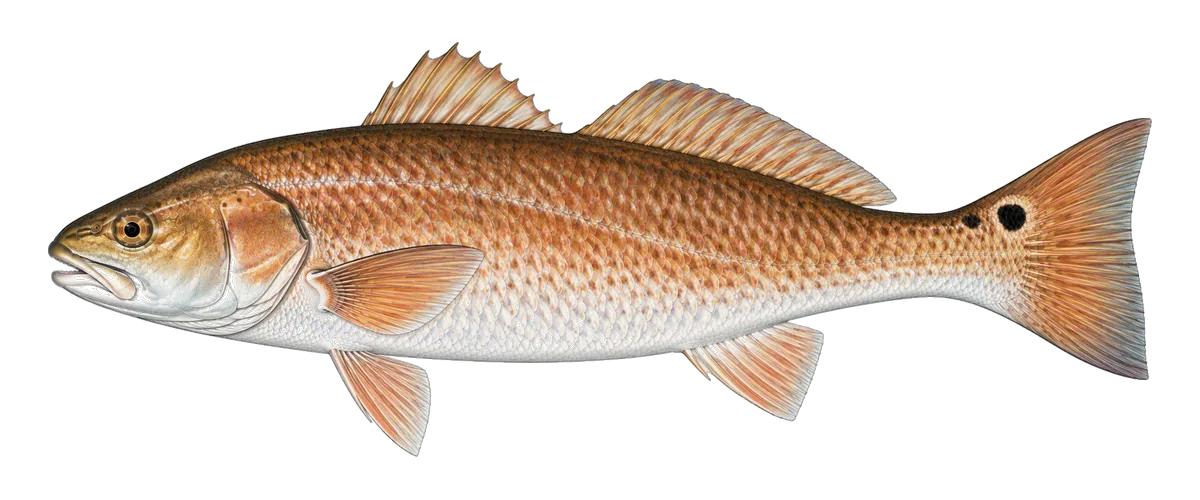
There's no single redfish size limit. Every state sets its own, most of them use a slot (a minimum and a maximum size, so the small fish grow up and the big breeders go back), and Florida goes further and sets its rules by region, with the Indian River Lagoon catch-and-release only. The cards below show each state's size, bag and season from the rules Taklbox checks your catch against, each with a link to the agency's official page. Rules change, and two states changed theirs in 2026, so tap through before you keep a fish.
Below: what a slot limit is and why redfish have one, how to measure a red the way a game warden does, and the red drum rules for all 13 states Taklbox has on file, from Texas to Connecticut.
What is a slot limit, and why do redfish have one?
A slot limit is a size window. A fish inside it can be kept; a fish under the minimum or over the maximum goes back. On the cards below, a slot shows as a range marked "slot", and every one is measured in total length.
Redfish are a textbook case for a slot because of how they grow up:
- The young ones live where we fish. Juvenile red drum crowd the estuaries, marshes and inlets, and fish older than about four move to deeper water, according to the Atlantic States Marine Fisheries Commission (ASMFC).
- They spawn late. ASMFC says males mature at one to four years old and females at three to six. By the time a red joins the spawning stock, South Carolina's marine researchers note, it has outgrown the top of the size limit.
- The big ones carry the stock. A large female can produce up to two million eggs in a season, ASMFC notes.
The slot lets anglers keep the middle-sized fish while enough young reds "escape" the inshore fishery to reach spawning age. The same researchers put it simply: the more restrictive the regulations, the more sub-adults survive to spawn, and the healthier the adult population.
It works. Heavy fishing crashed red drum in the 1980s: in the mid-1980s, Alabama Extension notes, Gulf fishermen harvested about 12.7 million pounds of redfish in a single year. By the late 1980s, all harvest in Gulf federal waters was stopped, and on the Atlantic coast a 2007 executive order bans harvest or sale of red drum from federal waters. So a red caught in federal waters goes back, wherever you fish. Federal protection for the offshore spawning schools, plus strict state rules inshore, rebuilt the fishery.
The work isn't finished. ASMFC's 2024 assessment found the northern stock (New Jersey through North Carolina) not overfished, though fishing pressure on it has been rising, and the southern stock (South Carolina through Florida's east coast) overfished. In October 2025 it told Georgia and South Carolina to cut harvest, which is why both changed their rules in 2026. Florida's 2022 overhaul was judged enough on its own.
How to measure a redfish
Every state on file measures red drum by total length. Florida's FWC defines it as the distance from the most forward point of the head, with the mouth closed, to the farthest tip of the tail with the tail compressed or squeezed, while the fish is lying on its side. South Carolina words it the same way, closed mouth to pinched tail, and Mississippi calls it a straight line from the tip of the snout to the tip of the tail.
Step by step:
- Lay the fish on its side on a measuring board, or a tape laid flat on a hard surface.
- Close its mouth and push the snout flush against the end of the board.
- Pinch the tail lobes together and read the length at the farthest tip.
- Measure straight, never over the curve. FWC warns that a flexible tape run along the body reads longer than the fish really is.
A board with an upturned end at a right angle, the kind Texas Parks and Wildlife's biologists and game wardens use, makes this easy. A TPWD Coastal Fisheries article on measuring fish lists the usual mistakes: measuring on a cooler lid or a tape with no backstop, the head not tight against the end, and the mouth left open. In its side-by-side photos, a fish read most of an inch longer on a cooler lid than on a proper board. Don't count on ice to shrink a fish, either: a 1989 TPWD study found the average loss was a few millimeters.
With a slot, a bad measurement can hurt you at both ends. A fish that looks just inside the top on a cooler lid can be over on a warden's board. The TPWD article suggests leaving yourself a margin, and for redfish that means at the bottom of the slot and the top.
Snap the fish before it goes back or into the cooler. On iPhone Pro models, Taklbox measures its length from the photo and logs it with the catch. For a red right at either end of the slot, a board is the final word.
Redfish size limit in Florida
Florida has managed red drum by region since 2022. FWC splits the coast into nine regions. All of them except the Indian River Lagoon share the same slot and per-person bag, and all are open year-round, but the vessel limit differs: it's bigger in the Panhandle, Big Bend and Northeast regions than from Tampa Bay south and on the Southeast coast.
- Indian River Lagoon: catch-and-release only, from New Smyrna Beach south to the Martin–Palm Beach county line.
- For-hire trips: the captain and crew can't keep a bag limit of red drum.
- Gear: hook and line or cast net only. Spearing, gigging, bowfishing, snatch hooking and multiple hooks with natural bait are all illegal for red drum.
- Keep it whole: a red must stay in whole condition until you're ashore, so no filleting on the boat.
- Biscayne National Park has its own rules for red drum.
Because the limits change at region lines, where you caught the fish matters as much as its length. Taklbox checks the rules where you caught it and links to FWC's page every time.
Redfish size limits on the Gulf coast
Every Gulf state uses a slot, but two of them let you keep a fish over it in some cases. Texas does it with a tag, Mississippi within the daily bag.
Redfish size limit in Texas
Texas uses a slot with a daily bag, plus a tag for a big fish. The Red Drum Tag comes with the saltwater fishing endorsement and any license package that includes it, and it lets you keep a red over the slot each license year, in addition to the daily bag. If you've used it, a Bonus Red Drum Tag, sold wherever licenses are sold, covers another oversized red that license year. The One-day All-Water license comes with its own one-day red drum tag.
How to tag one, per TPWD:
- Printed license: tag the fish as soon as you keep it. Fill in every space on the tag, cut out the day and month, and tie it with string or wire around the narrowest part of the tail, just ahead of the tail fin.
- Digital license: report the fish in the Texas Hunt & Fish app instead of attaching a tag.
The card also covers two lakes near San Antonio, Braunig and Calaveras, where red drum live in fresh water. Their rule has a minimum size but no maximum.
Redfish size limit in Louisiana
Louisiana uses a straight slot with a daily bag, and nothing over the slot may be kept. Its card also notes that taking or possessing red drum in federal waters is prohibited.
Redfish size limit in Mississippi
Mississippi's card shows a slot, but its rule lets an oversized red count toward the daily bag, as the note on the card spells out. The Mississippi Department of Marine Resources measures total length as a straight line from the tip of the snout to the tip of the tail.
Redfish size limit in Alabama
Alabama uses a slot that starts a little lower than its Gulf neighbors'. Some older guides, including a 2018 Alabama Extension article, say Alabama lets you keep a fish over the slot. The current Marine Resources table doesn't allow it, and neither does the card.
Redfish size limits in Georgia and the Carolinas
Georgia and South Carolina sit in the southern stock that ASMFC found overfished, and both have rewritten their red drum rules: South Carolina's new rules took effect in 2026, and Georgia's take effect on Jan. 1, 2027. If you learned the old numbers, check the cards. North Carolina is in the healthier northern stock.
Adult reds spawn in nearshore waters in summer and fall, ASMFC says, and the big fish anglers meet along these beaches and inlets then are over the slot, so they go back. For where to find them this time of year, see where redfish go in the fall; for a short-leader rig that hooks bulls in the corner of the mouth, see the best bait for redfish.
Redfish size limit in Georgia
Georgia is moving its slot up and lowering its daily bag to meet the cut ASMFC required, starting Jan. 1, 2027. Until then the card shows the rule in force today, with the coming one in its note. Georgia still uses a plain slot.
Redfish size limit in South Carolina
South Carolina's new rules took effect on July 1, 2026, under Act No. 231. The slot moved, and the card shows both a per-person bag and a per-boat cap. Red drum may only be taken by rod and reel or gig, gigging them is off-limits in winter, and possession in federal waters is prohibited.
Redfish size limit in North Carolina
North Carolina uses a slot with a small daily bag, and it's unlawful to possess a red over the slot. Reds may not be taken with a gig, spear or gaff. The same rule covers the coastal fishing waters and the inland ones.
Red drum size limits from Virginia to Connecticut
North of the Carolinas, you'll hear them called red drum or channel bass as often as redfish. ASMFC notes that few have been reported north of Chesapeake Bay in recent years, but they turn up, and these states set rules for them.
Red drum size limit in Virginia
Virginia's Marine Resources Commission sets a slot for tidal waters. Back Bay, Lake Tecumseh and the North Landing River fall under the state's inland rules and have their own row on the card.
Red drum size limit in Maryland
Under ASMFC's 2025 addendum, Maryland and the Potomac River Fisheries Commission adopted Virginia's rule, so the slot and bag now match across the bay's shared waters. For Maryland anglers, that meant a bigger daily bag than before.
Red drum size limit in Delaware
Delaware uses a slot in its tidal waters.
Red drum size limit in New Jersey
New Jersey, the northern end of ASMFC's red drum plan, uses a slot in its marine waters.
Red drum size limit in Connecticut
Connecticut sits outside ASMFC's plan, which runs from New Jersey to Florida, but it still sets a rule: a maximum size with no minimum.
Not sure whether you've got a red or a black drum? They have separate rules, and small ones get mixed up. See red drum vs black drum for how to tell them apart, and more fishing rules explained.
Frequently asked questions
What is the slot limit for redfish in Florida?
Every Florida region except the Indian River Lagoon has the same slot and per-person bag, with a vessel limit that varies by region. The Indian River Lagoon is catch-and-release only. The Florida card above has each region's numbers.
How many redfish can you keep in Texas?
The daily bag on the Texas card, all inside the slot, plus, each license year, an oversized red with your Red Drum Tag and another with a Bonus Red Drum Tag. Fish kept on a tag don't count toward the daily bag.
Can you keep a redfish over the slot?
In most states, no. Texas allows it with a red drum tag, and Mississippi lets an oversized fish count toward the daily bag. Nowhere can you keep one from federal waters.
How do you measure a redfish?
By total length: lay it on its side, close its mouth, push the snout against the end of the board, pinch the tail lobes together, and measure in a straight line to the tip of the tail.
Can you keep redfish in federal waters?
No. Red drum harvest has been banned in Gulf federal waters since the late 1980s, and a 2007 executive order bans harvest or sale from Atlantic federal waters. Release any red caught out there.