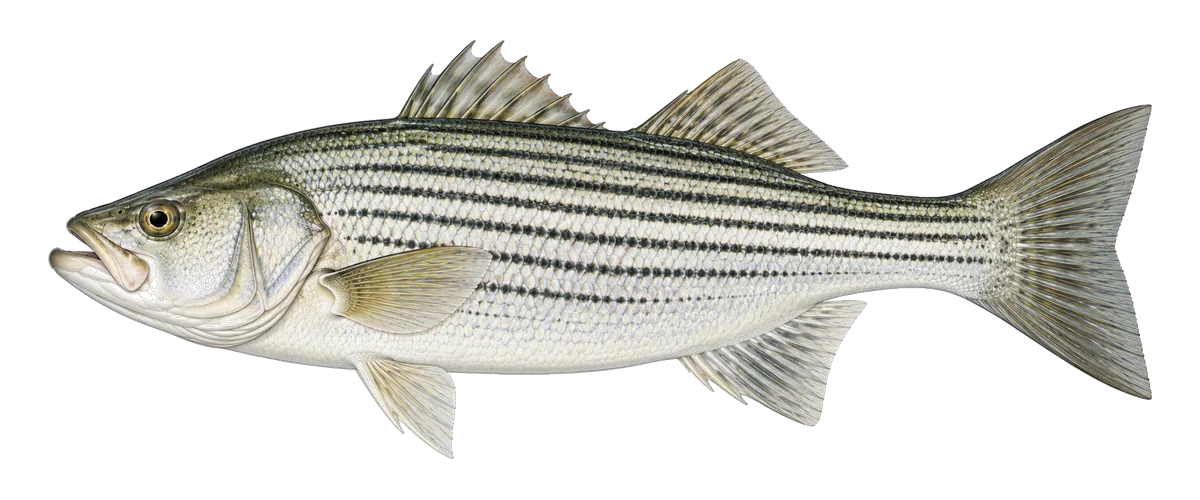
The best bait for striped bass on the Atlantic coast is menhaden (bunker), fished live or as a fresh chunk, and a live eel after dark. Clams and bloodworms are the standbys in the surf and the rivers, especially in spring. On lakes, landlocked stripers want live gizzard shad or herring on down-lines and planer boards. With lures, a bucktail jig, a slowly swum plug and a soft plastic sand eel or paddletail catch stripers almost everywhere they live.
Below: the fall run, each bait and its circle hook rig, the lures, fishing from shore, at night and in rivers, lake and California stripers, and the rules.
When stripers bite: the Atlantic fall run
The Atlantic States Marine Fisheries Commission (ASMFC), which manages stripers from Maine to North Carolina, says the coastal fish move north in summer and south in winter, wintering from offshore New Jersey to North Carolina. In spring, mature fish run up rivers to spawn. The Chesapeake Bay produces most of the coastal stock, with significant help from the Hudson and the Delaware.
The fall run is the main event. Salt Water Sportsman's Nick Honachefsky tracks it down the coast from October through December, past Connecticut and Long Island first and thick off New Jersey in November and December, when inshore water sits around 55 to 65°F. On The Water's Tom Lynch finds November is usually the best month on the Jersey surf, with the run winding down to smaller fish in late December and early January.
Cooling backwaters flush out the bait the bass follow: spearing, mullet, sand eels, bay anchovies, herring, bunker and squid. Diving birds mark the feeding fish, and matching the bait gets you most of the way there.
These fish are under tight management. ASMFC lists the stock as overfished, though overfishing is no longer occurring, and has put restrictive measures in place to cut fishing deaths and rebuild it. NOAA Fisheries notes that federal waters, beyond the three-mile line, remain closed to all striped bass fishing. ASMFC also says the recreational fishery is mostly catch and release, and that deaths after release add significantly to the total, which is why the bait rules center on circle hooks.
Taklbox saves each catch with its bait, tide, moon and barometer reading, so after a fall or two you can see what your best nights have in common.
The best bait for striped bass in saltwater
Bunker (menhaden), live or chunked
Menhaden are the striper's staple and the top big-fish bait on the coast. Taklbox's striped bass profile names a fresh bunker chunk, fished on the bottom in the surf or a chum slick, among its top baits.
Live bunker. Honachefsky snags one from a school with a weighted treble, then switches to a 9/0 inline circle hook and free-lines it back into the fish. Capt. Greg Cudnik of Long Beach Island, New Jersey, hooks live bunker near the tail on a 9/0 wide-gap circle hook, with a light egg sinker above a swivel and about two feet of 50-pound fluorocarbon. He keeps steady pressure on a bite and lets the hook set itself. Rhode Island's Capt. Jack Sprengel bridles the bait to the hook with floss.
Bunker chunks. Chesapeake guide Capt. Greg Shute fishes chunks on a fish-finder rig: a sliding sinker, a swivel, a foot and a half of 25-pound fluorocarbon and a 6/0 to 8/0 light-wire circle hook. He passes the hook lightly through a small piece so the bait doesn't fill the gap.
Live eels
The live eel is the classic night bait and a big-fish bait from summer into fall. In Salt Water Sportsman's "Art of the Eel," Gary Caputi drifts them after dark over rocky high spots, rips and channels, where bass move up to feed. His method:
- Chill the eels briefly on ice so you can handle them, then hook them through the lower jaw and out an eye socket. It holds through repeated hits and on the cast.
- Use a 5/0 circle hook for eels under 10 inches and a 6/0 or 7/0 for bigger ones.
- Drift with the reel in free-spool until the eels swim just off the bottom. In a slow drift, use no weight; in deep water or hard current, use a three-way rig with the sinker on a light dropper that breaks off if it snags.
- On the bump, don't let the bass run with it and don't swing. Let the line come tight, then lift.
Virginia's Capt. Kenny Louderback, who slow-trolls eels in late winter, hooks them through the nose so they swim straight and waits for the fish to pull line off the reel.
The rocky humps and channel edges eels work best over show up on a chart before you ever mark a fish. Taklbox Pro shades charted depth on the map along the coasts.
Clams
Clams are a surf and river standby, in fall and especially in spring. Lynch fishes them in the Jersey surf and wants them fresh, not salted. On the lower Delaware River, The Fisherman's Bob Bott finds clams start working once the water reaches about 47°F. Clam meat tears, so he uses a thick inline circle hook and borrows a salmon angler's trick: tie the bait into a bit of mesh egg-bag material so it survives the cast and small fish can't strip it. If black drum find your clams first, see the best bait for black drum.
Bloodworms and sandworms
Worms are the cold-water bait. Bott calls bloodworms key from early March until the river hits 47°F, threaded on a 7/0 or 8/0 inline circle hook. In California's Delta, bloodworms and pile worms are popular too.
Herring, spot and other live baits
Big bass eat herring; check your state's rules before using them as bait. In the Chesapeake, live spot are a favorite. Shute hooks them through the back, between the head and the dorsal fin, so the bait swims down.
How to rig bait for striped bass: circle hooks
Use an inline (non-offset) circle hook with any natural bait. ASMFC's Addendum VI made circle hooks mandatory when fishing bait for striped bass, to cut release deaths. Rhode Island, Connecticut and New Jersey note the rule on their cards below, and in the Chesapeake, Maryland DNR requires a non-offset circle hook whenever you chum, and generally when you live-line. Maryland defines one as a hook "with the point turned perpendicularly back to the shank," in line with it, not bent to the side.
- Don't set the hook. When the line comes tight, reel steadily. The hook slides to the corner of the mouth and sets itself.
- Size up. Maryland DNR suggests 8/0 to 9/0 circles for stripers. Sprengel goes about 30% larger than the J-hook he'd otherwise use, and ties it on with a Palomar or uni knot so it can pivot into the jaw.
Three striped bass bait rigs cover nearly all of it:
- Fish-finder rig: a sliding sinker, a swivel, a short fluorocarbon leader and a circle hook, for chunks, clams and worms from shore or at anchor.
- Three-way rig: main line, a short sinker dropper and a longer leader, for drifting eels or bunker over structure in current.
- Free-line: a leader and a hook, plus a split shot if needed, for live bunker, eels and spot in light current.
The best lures for striped bass
Bucktail jig. The Fisherman's Matt Broderick calls a 1- to 2-ounce bucktail nearly universal in the fall surf and carries several weights. Bounce it along the bottom, or, when sand eels are the bait, swim one with a straight tail steadily near the bottom. On lakes, a bucktail catches schooling stripers too (more below).
Swimming plugs. Minnow-style swimmers like the Daiwa SP Minnow, needlefish, darters and metal-lipped swimmers are the surfcaster's night lures. Honachefsky's rule: retrieve slowly. Broderick finds needlefish shine when sand eels are the bait.
Soft plastic sand eels and paddletails. In late fall, sand eels are often the most plentiful bait on Jersey beaches, according to Lynch, and slim soft plastic eels match them. Honachefsky bounces paddletails and sand eels off the bottom.
Metal. When bass blitz on peanut bunker, anchovies or spearing, Broderick throws small tins and epoxy jigs, which cast a long way. Lynch likes black metal in rough surf at night.
Topwater. Pencil poppers and walk-the-dog plugs draw explosive strikes when bass are busting bait at first light, dusk and in blitzes. Broderick works pencils and spooks with sharp snaps of the rod tip by day when mullet are around.
Teasers. A small fly or soft plastic tied ahead of a plug, like a little baitfish chased by a bigger one. Lynch fishes them at night and over the bar in skinny water.
Best bait for striped bass from shore and surf fishing
In the surf, stripers hunt the structure that breaks up a beach: bars, holes and rips.
- Read the beach. Lynch looks for holes, rips and bar edges at high water, and wades out onto the bars at low tide to cast into deeper water. Broderick finds outgoing tides concentrate bait around inlets, while incoming water often turns on open beaches.
- Bait. Bunker chunks or clams on a fish-finder rig, the rod in a sand spike. Bott fishes 10.5- to 12-foot rods that cast 3 to 6 ounces, with grip-wire sinkers that hold in current.
- Blitzes. When birds and bass erupt, cast to the edges, where a fleeing baitfish is easier for a bass to pick off, Honachefsky says.
- Weather. Lynch finds the fishing can turn on just before a northeaster hits, as the barometer drops.
Much of the striper surf is fished on foot from public beaches and parks. Taklbox Pro shades public land on the map, a starting point for finding shoreline to fish.
Best bait for striped bass at night
Taklbox's profile notes that stripers feed hardest at night and around tide changes. Broderick says many surfcasters log their biggest bass between midnight and dawn in October, and many plan around the dark of the moon, when big fish move into shallow water.
- Live eel, drifted along rips and rocky shorelines.
- Plugs: darters, bottle plugs and metal-lipped swimmers fished slowly along the edge of an inlet rip; needlefish when sand eels are around; soft plastic eels on a jighead.
- A teaser ahead of the plug, the way Lynch fishes it.
- Slow down. Honachefsky's rule for surf plugs is a slow retrieve.
Best bait for striped bass in rivers
In spring, mature stripers run up coastal rivers to spawn as the water warms. On the lower Delaware, Bott follows the water temperature: bloodworms from early March to about 47°F, then clams, then bunker once the river reaches 50 to 52°F. He fishes shallow mud and sand flats, which warm quickly, on a low-to-incoming tide on bright, calm days. Early-season outgoing tides can carry cold runoff that shuts the bite down.
Some spawning rivers are catch-and-release in spring; Delaware's card below notes its window.
Inland, stripers run rivers too. Texas Parks and Wildlife says Lake Texoma's stripers run up both river arms in February. On Alabama's Lake Martin, guide Jim Parramore heads up the Tallapoosa River in April, when rain brings a strong current.
Best bait for striped bass in freshwater (lake stripers)
Landlocked stripers thrive in reservoirs across the country. Many lakes are stocked, though a few sustain their own; at Lake Texoma, natural reproduction was first documented in 1974, TPWD says. Lake stripers eat shad and herring, and live shad or herring is the bait.
Live shad and herring. Gizzard shad are the standard; TPWD recommends them at Texoma. Parramore fishes 4- to 5-inch shad in winter and switches to jumbo gizzard shad of a pound and a half or more in spring, once the water reaches 53 to 55°F. He warns that shad handle stress poorly once the water passes 56°F, and finds tailrace-caught shad live longer than lake-caught ones. In Tennessee, Game & Fish's Phillip Gentry free-lines skipjack herring as soon as they're caught, since they die quickly in a tank.
Down-lines. A weighted line straight down to fish you've marked on sonar. Parramore's winter rig: a 2-ounce sinker on 20-pound line, a 3-foot fluorocarbon leader and a 1/0 or 2/0 circle hook, with the bait a few feet above the fish. In summer, the fish go deeper, as deep as 80 feet at Martin, and down-lines are his go-to.
Free-lines and planer boards. In spring and fall, Parramore free-lines big shad behind planer boards along creek and slough edges in 2 to 5 feet of water, letting out about 40 feet of line before clipping on the board, with a 5/0 circle hook.
Summer heat. In-Fisherman reports that inland stripers want water below the low 70s and get stressed above it. Deep lakes often form a thermocline 25 to 40 feet down, and a temperature probe finds it. Trollers there run bucktails tipped with swimbaits and deep-diving plugs.
Lures for surfacing schools. TPWD says Texoma's stripers often surface under diving gulls in summer, fall and winter. Heavy jigs and slabs work, as do plastic shad "retrieved rapidly just under the water's surface," and topwater plugs. Parramore casts a 1/2-ounce bucktail with a curly tail into the school, lets it sink about five seconds and reels it back slow and straight. The bigger fish are often on the outer edges.
Many striper lakes also hold hybrid stripers and white bass, and several states count stripers and hybrids together toward one daily limit. A striper's stripes run unbroken from gill to tail; a hybrid's are broken, and a white bass has only one unbroken stripe. Not sure which you're holding? Snap it.
If you're chasing largemouth on the same lake, see fall bass fishing.
Best bait for striped bass in California
California's best-known striper water is San Francisco Bay and the Sacramento-San Joaquin Delta. California's Department of Fish and Wildlife (CDFW) lists the baits by water:
- Delta: threadfin shad are the most common bait, usually split and folded flesh side out. Sardines, anchovies, bloodworms and pile worms are popular too.
- San Francisco Bay: live shiner perch or anchovies, drifted.
- San Pablo and Suisun bays: sculpins (bullheads) and gobies (mudsuckers), alive or dead.
CDFW says to fish the bait near the bottom. Fishing picks up in March, the spawning run goes from April to mid-June, and the fall migration back into the Delta can start in October. From shore, CDFW points to the Sacramento River from Courtland to Colusa in spring, the San Joaquin near Stockton in spring and fall, and the Berkeley Fishing Pier.
California's card on file is its freshwater rule, and it notes that some regions differ, so check the official link for your water.
Striped bass rules on the Atlantic coast and in Texas
Along the coast, ASMFC sets the framework, each state writes its own rules within it, and most use a narrow slot. The cards come straight from the data Taklbox checks your catch against, with each state's official link.
Rhode Island, Connecticut and New Jersey each note their circle hook rule on the card.
Delaware's card notes its spring catch-and-release window and a separate summer rule in Delaware Bay.
In the Chesapeake Bay and the coastal waters of Virginia and North Carolina, the striped bass rules come from Maryland DNR, Virginia's VMRC and N.C. Marine Fisheries: check theirs before you keep one there.
Inland, states write striper rules lake by lake. Texas has a statewide rule plus its own for Lake Texoma (shared with Oklahoma) and Toledo Bend.
Not sure whether the striper in your hands is legal where you caught it? Snap it: Taklbox names it, measures it on iPhone Pro models, and checks the slot, bag and season where you caught it.
How to release a striped bass
Most stripers go back. Maryland DNR's release advice:
- Use medium to heavy tackle and land the fish quickly.
- Keep it in the water if you can. Use a rubber or soft mesh net and wet gloves, and never hold it with a rag, which rubs off its slime.
- Revive a tired fish by moving it slowly forward through the water, pushing water over its gills, and let it swim off.
- Avoid catch and release of medium and large stripers in brackish water warmer than 80°F, and on days when the air is over 95°F.
Lynch recommends single barbless hooks for quicker, safer releases. Snap a photo before you let the fish go: on iPhone Pro models, Taklbox measures its length from the picture, so the release still goes in your log.
Frequently asked questions
What is the best bait for striped bass in the Chesapeake Bay?
Menhaden, chunked on a fish-finder rig along channel edges and drops or used as chum, and live spot or live menhaden. Maryland requires a non-offset circle hook whenever you chum, and generally when you live-line, for stripers.
What is the best bait for stripers and bluefish?
Bunker, live or chunked, catches both, and so do metals and poppers when they're blitzing together. Bluefish teeth cut light leaders and shred soft plastics, so carry spares.
Do striped bass bite better at night?
Often, and especially the big ones. Many surfcasters log their biggest fall bass between midnight and dawn. A live eel or a slowly swum plug is the night bait. For more bait guides, see Taklbox bait and lure guides and the best bait for redfish, which covers the surf fish-finder rig in more detail.